Provinces
🏞️Kanchanaburi Province
History, Jungle, and River Adventure
History, Jungle, and River Adventure
The train approaches the bridge slowly, wheels clicking rhythmically across the iron spans that stretch over the Khwae Yai. Passengers crowd the windows, cameras ready, as the famous silhouette comes into view—curved steel trusses rising from concrete pillars, framed by jungle-covered limestone hills. For a moment, it's just another picturesque railway crossing. Then you remember: this bridge was built by men dying of starvation, disease, and brutality. Around 13,000 Allied prisoners of war and tens of thousands of Asian laborers perished constructing this 415-kilometer railway through some of Southeast Asia's most hostile terrain. The beauty of Kanchanaburi is inseparable from its tragedy.
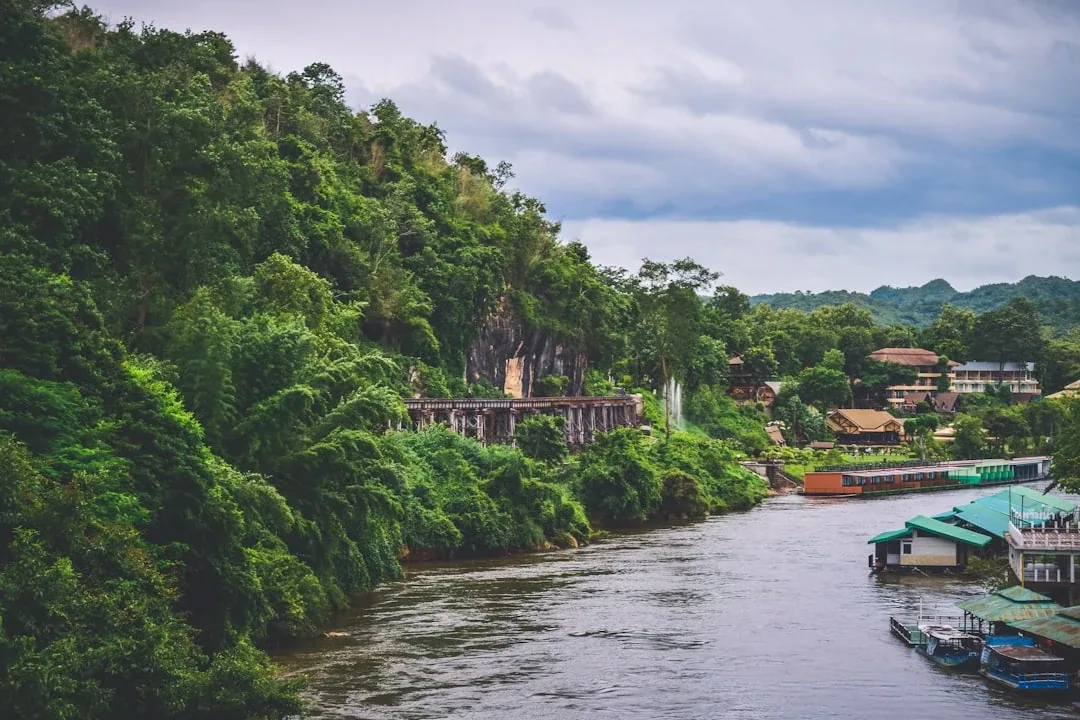
Kanchanaburi Province occupies roughly 19,482 square kilometers of western Thailand — the country's third-largest province by area — stretching from 130 kilometers west of Bangkok to a long Myanmar border. The River Kwai is actually two rivers — the Khwae Yai and Khwae Noi — which meet in Kanchanaburi city to form the Mae Klong; together they cut through limestone mountains draped in dense jungle, creating the dramatic geography that made the region strategically valuable during World War II and spectacularly beautiful today. Multiple national parks and the UNESCO-listed Thungyai-Huai Kha Khaeng Wildlife Sanctuaries protect vast tracts of forest harboring elephants, gibbons, and some of Thailand's most impressive waterfalls. The provincial capital, also called Kanchanaburi, serves as base for exploring both the sobering historical sites and the stunning natural attractions.
What makes Kanchanaburi compelling is how it juxtaposes these elements without diminishing either. In the morning you stand in the immaculately maintained war cemetery, reading headstones of Australian, British, and Dutch servicemen who died at 19, 21, 23 years old (American POW remains were repatriated after the war and are not buried here). By afternoon you're swimming in turquoise pools at the base of Erawan Falls, where seven tiers of waterfalls cascade through jungle so lush it feels primordial. The province doesn't try to reconcile these experiences—it simply offers both, allowing visitors to engage with history's darkness and nature's indifferent beauty in the same day.
"Around 13,000 Allied prisoners and tens of thousands of Asian rōmusha laborers died building the Death Railway. The beauty of Kanchanaburi is inseparable from its tragedy."
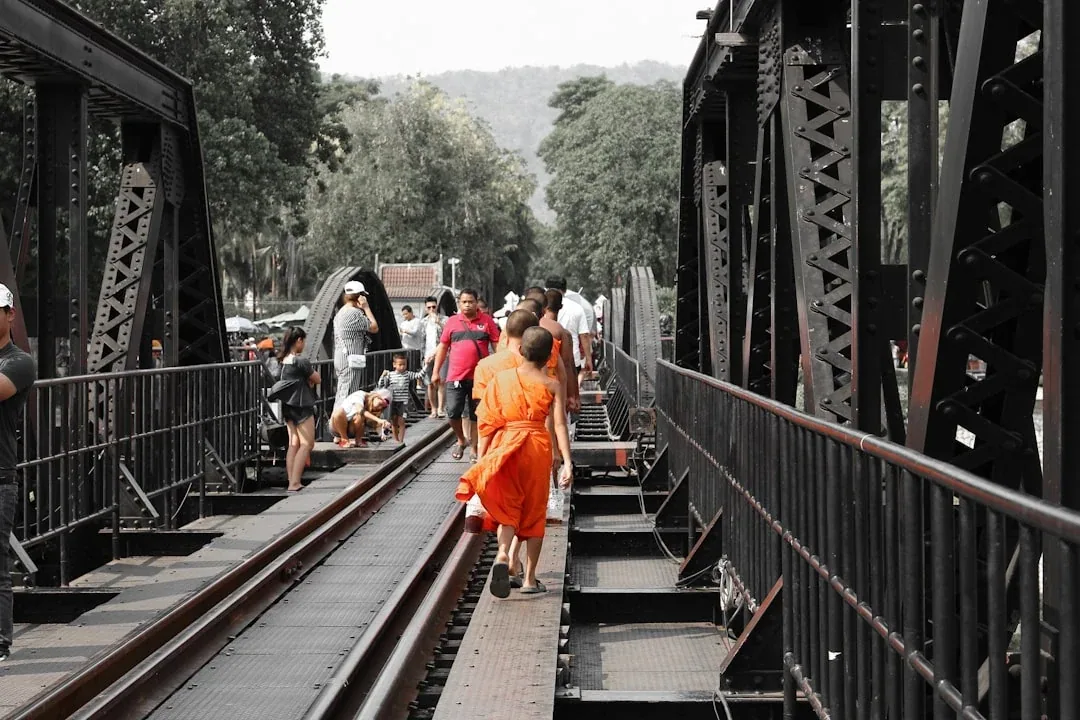
The Bridge on the River Kwai stands as Thailand's most visited war memorial. The river it crosses was historically a stretch of the Mae Klong, but Thailand officially renamed this section the Khwae Yai in the 1960s to match the fame of Pierre Boulle's novel and David Lean's 1957 film. You can walk across the steel span, stepping aside when trains approach (yes, it's still an active railway). The curved steel sections were brought from Java by the Japanese; Allied bombing destroyed the central spans in 1945, and the curved trusses you see today were replaced by Japan as war reparations after the war. Looking down at the slow-moving water below, it's difficult to imagine the conditions under which this was built: prisoners working 18-hour days, beaten for working too slowly, dying from cholera, dysentery, malnutrition, and exhaustion.
The Thailand-Burma Railway Centre in town provides essential context that the bridge alone cannot convey. The museum documents the entire railway project through photographs, artifacts, survivor testimonies, and detailed explanations of how the Japanese military command made decisions that guaranteed massive loss of life. The exhibits are sobering without being sensationalistic, educational without simplifying. You leave understanding that this wasn't an isolated atrocity but a systematic exploitation of human life for military logistics. Entry costs 120 THB and requires at least 90 minutes to appreciate properly.
Across the street, Kanchanaburi War Cemetery maintains 6,982 graves with quiet dignity. The Commonwealth War Graves Commission keeps the grounds immaculate—perfectly trimmed grass, flowering plants, bronze markers that record each man's name, rank, age, and often a personal message from family. "He gave his today for our tomorrow." "In loving memory of our dear son." "Age 19." The ages hit hardest. Walking through on a quiet weekday morning when you might be the only visitor, the scale of loss becomes visceral in a way statistics cannot convey.
Hellfire Pass, 80 kilometers northwest of town, offers the most powerful historical experience. The pass earned its name from the hellish glow of torches and fires as prisoners worked through the night, cutting through solid rock with hand tools under guard brutality. The Australian government built an excellent museum at the site, then created a 4-kilometer walking trail that follows the original railway cutting through the jungle. The audio guide features survivor testimonies—hearing elderly men describe watching their friends die while you walk the exact ground where it happened creates an emotional impact that no museum exhibit can match.
The trail takes 2-3 hours, involves significant up and down through jungle, and should not be rushed. Bring water and start early to avoid midday heat. The museum opens at 9am and closes at 4pm, but the trail is accessible beyond those hours. Free entry, though donations are encouraged. This is the single most important historical site in Kanchanaburi, more moving than the bridge and essential for understanding what the Death Railway actually meant for those who built it. For broader context on Thailand's role in the war, our guide to Thailand's monarchy touches on the complex political situation during WWII.
Erawan National Park, around 50 kilometers northwest of Kanchanaburi city, offers a dramatic shift from the province's somber history. The park's centerpiece—Erawan Falls—cascades down seven distinct tiers over 1.5 kilometers, each level creating pools of startling turquoise water where you can swim among small fish that nibble dead skin from your feet (natural fish spa, basically). The mineral content in the water creates the vivid color, and the jungle setting—massive trees, hanging vines, bird calls echoing through the canopy—feels almost impossibly lush.
Most visitors stop at tiers 1-3, which are easily accessible via paved paths and see heavy traffic on weekends. Tiers 4-7 require more effort, with increasingly steep and slippery trails, but reward with progressively emptier pools. I've had tier 7 entirely to myself on weekday mornings—swimming in the cool water with jungle pressing in from all sides, the only sounds water and wildlife. To experience this, arrive when the park opens (8am), move quickly through the lower levels, and push straight to the top. The climb takes about 45 minutes at a steady pace.
Park entry costs 300 THB for foreigners, 100 THB for Thais (the dual pricing that's standard at Thai national parks). Lockers available for 20 THB. Bring water shoes or sandals with good grip—the rocks get slippery. Weekends see huge crowds, especially November through February when Bangkok families flock here. If you must visit on weekends, arrive by 8am or accept that you'll be sharing the pools. The park prohibits alcohol and smoking, enforces modest swimwear (no bikinis at higher tiers), and asks visitors to not use soaps or lotions in the water.
Beat the crowds: Arrive at 8am opening, head directly to tier 7, then work your way back down. You'll have the best pools nearly empty and swim in progressively busier tiers as crowds are still climbing up.
Weekday advantage: Visit Monday-Thursday if possible. Weekend crowds can exceed 1,000 people, turning the trails into congested highways and the pools into public swimming pools. Weekdays might see 100-200 visitors total.
Rainy season magic: June-October means fewer tourists and waterfalls at peak flow. Trails get muddy and leeches appear, but the trade-off is dramatic water volume and near-empty pools. Bring leech socks or use insect repellent on ankles.
Beyond Erawan, Kanchanaburi province harbors several other national parks worth exploring. Sai Yok National Park, 100 kilometers northwest, offers caves, waterfalls, and bamboo rafting on the River Kwai with far fewer visitors than Erawan. The park is home to the world's smallest mammal—Kitti's hog-nosed bat, about the size of a bumblebee. Khuean Srinagarindra National Park, the largest in the province, contains the spectacular seven-tier Huai Mae Khamin Falls and the Srinagarind reservoir. Khao Laem National Park, near the Myanmar border, features the massive Khao Laem reservoir surrounded by mountains. The Mon community at Sangkhlaburi — with its long wooden Saphan Mon bridge and Wat Wang Wiwekaram — sits at the far western edge of the province, while Three Pagodas Pass nearby provides access to genuinely remote jungle and the frontier atmosphere of the Thai-Myanmar border.
Kanchanaburi city itself is pleasant rather than compelling—a small provincial town where the Khwae Yai and Khwae Noi converge to form the Mae Klong. The main attraction is the riverside location and the quiet, slow pace that comes with being off the main tourist circuits. Several streets of guesthouses and restaurants cater to foreign visitors, but the town maintains a distinctly Thai character. Markets sell to locals, not tourists. Street food vendors cook for Thai palates. The night market on weekends brings families out for grilled fish, som tam, and the kind of casual socializing that defines small-town Thailand.
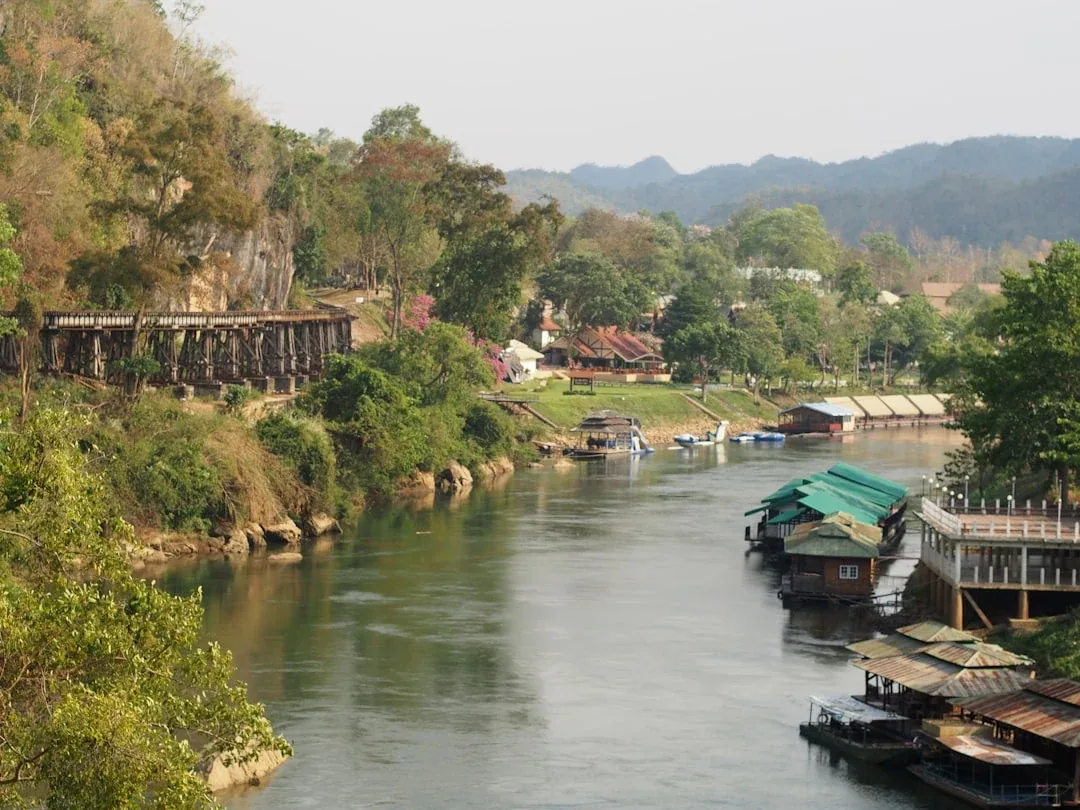
What makes staying in Kanchanaburi unique is the floating accommodations. Dozens of raft houses and floating hotels line the river—wooden structures built on pontoons, ranging from basic backpacker rooms (400-800 THB nightly) to comfortable floating resorts with restaurants, pools, and river views (2,000-4,000 THB). You fall asleep to water lapping against the pontoons, wake to river mist, and can jump directly into the water from your balcony. It's gimmicky in concept but genuinely pleasant in execution, especially for a few nights.
For longer stays, monthly rentals in town run remarkably cheap—5,000-10,000 THB for basic Thai-style apartments with fan, 8,000-15,000 THB for more comfortable places with AC and better furnishings. Riverside bungalows cost more (10,000-20,000 THB monthly) but offer better quality of life if you value waking up to river views. The town is small enough that nothing is far from anything else—you can walk across the center in 15 minutes, though the heat makes motorcycle rental (100-150 THB daily, 2,500-3,500 THB monthly) appealing for errands and exploring surrounding areas.
The expat community is small—probably 1,000-2,000 people total including surrounding areas—consisting largely of retirees, teachers, and the occasional remote worker who discovered the place and stayed. There's no organized expat scene like Chiang Mai or Bangkok, just loose social networks that form around guesthouses, cafes, and the handful of Western-style restaurants. Facebook groups provide information exchange, but much of the social life happens organically. It's good for independent people who create their own entertainment; limiting for those who need structured community or frequent social events.
Internet reliability is the primary concern for anyone considering remote work from Kanchanaburi. Home internet from AIS, True, or 3BB costs 400-600 THB monthly for advertised speeds of 15-30 Mbps, but actual performance varies significantly. Peak evening hours see slowdowns, rain can disrupt connections, and the infrastructure simply isn't as robust as Bangkok or Chiang Mai. Video calls work most of the time, cloud-based work is manageable, but large file transfers require patience. Mobile 4G provides surprisingly good backup coverage—buying a monthly unlimited data package (300-400 THB) and using mobile hotspot when needed becomes standard practice.
Co-working spaces essentially don't exist. The few cafes with decent WiFi and power outlets become de facto workspaces, but you're limited to coffee shop hours and dependent on their internet working that day. For critical work that absolutely cannot tolerate internet interruptions, Kanchanaburi probably isn't viable. For flexible remote work where an occasional lost day is manageable, it works fine with proper backup plans (mobile hotspot, accepting that you might need to work from a hotel in Bangkok for crucial deadlines).
Healthcare is adequate for routine needs but limited for serious conditions. Kanchanaburi Hospital (public) handles basic consultations (150-400 THB) and common ailments. Bangkok Hospital Kanchanaburi (private) offers higher standards with consultations at 600-1,200 THB and specialist appointments 1,000-2,000 THB. For major issues, specialized care, or complex procedures, you're looking at a 2.5-3 hour journey to Bangkok. Dental care is available and affordable. Pharmacies are well-stocked. But this is a provincial town, not a medical hub—health insurance with Bangkok hospital coverage and medical evacuation provisions becomes essential rather than optional. Our guide to Thailand's healthcare system explains what to expect at different hospital levels.
→ Rent (riverside bungalow): 12,000 THB – Comfortable accommodation with river views and AC
→ Utilities & internet: 1,500 THB – Electricity, water, internet package. Lower if you use fan instead of AC
→ Food: 10,000 THB – Mix of street food (40-80 THB meals), local restaurants (80-150 THB), occasional Western dining
→ Transport: 2,000 THB – Motorcycle rental, occasional car rental for national parks, fuel
→ Activities: 4,000 THB – National park entries, tours, entertainment, travel to Bangkok
→ Healthcare & gym: 1,500 THB – Basic health insurance contribution, no real gyms in town
→ Miscellaneous: 3,000 THB – Shopping, replacements, unexpected expenses
→ TOTAL: 34,000 THB (~$960 USD) for comfortable living
Food costs are extremely low if you eat Thai. Street food runs 40-80 THB per meal, local restaurants 80-150 THB. Fresh river fish grilled with chili and garlic might cost 120-180 THB for a generous portion. Night markets offer incredible variety at Bangkok prices from a decade ago. International food exists but is limited—a few Western restaurants serve pizza, pasta, burgers for 150-300 THB. Coffee culture is emerging with several decent cafes. If you can happily eat Thai food 80% of the time with occasional Western treats, food costs will be minimal. If you need daily Western meals and imported ingredients, you'll struggle.
Perfect for: History enthusiasts, nature lovers, weekend warriors from Bangkok, budget travelers, retirees seeking quiet riverside living, people who want easy access to national parks, those comfortable with small-town life
Less suitable for: Digital nomads needing reliable high-speed internet, those requiring extensive medical facilities, people wanting nightlife or shopping, families needing international schools, anyone uncomfortable with limited Western amenities
Best approach: Visit for a long weekend from Bangkok first. Walk the bridge, visit Erawan Falls, spend a night in a floating hotel. If the combination of history, nature, and quiet river life appeals more than the internet limitations and small-town constraints frustrate, consider a longer stay during cool season to properly assess.
Kanchanaburi sits 130 kilometers west of Bangkok via Highway 323, making it one of the most accessible provincial destinations from the capital. Buses depart Bangkok's Southern Bus Terminal (Sai Tai Mai) throughout the day, taking 2-2.5 hours and costing 100-150 THB. The buses are comfortable, frequent, and reliable. Minivans offer faster service (1.5-2 hours, 150 THB) with more frequent departures but less comfort and questionable safety records.
The train journey from Bangkok is slower (around 3 hours each way on the tourist train, longer on local services) but more atmospheric, especially if you book the morning departure that crosses the famous bridge. Trains depart from Bangkok's Thonburi station (not the main Krung Thep Aphiwat / Bang Sue Grand terminus), and the Thonburi–Nam Tok line is third-class ordinary only — a flat 100 THB tourist fare for foreigners regardless of distance. The railway follows the original Death Railway route for portions of the journey, adding historical significance to the practicality.
Driving from Bangkok takes 2.5-3 hours depending on traffic. The route is straightforward—Highway 4 west through Nakhon Pathom, then Highway 323 north to Kanchanaburi. Tolls add up to about 100 THB. Car rental in Bangkok costs 1,000-1,500 THB daily, worthwhile if you plan to explore multiple national parks or prefer the flexibility. Many guesthouses in Kanchanaburi arrange car rentals (800-1,200 THB daily) if you prefer to arrive by bus and drive around the province.
Within Kanchanaburi, the town center is walkable but the heat makes motorcycle rental practical (100-150 THB daily). Tuk-tuks cost 40-100 THB for trips around town. Songthaews (shared pickup trucks) run fixed routes for 20-40 THB per person. Grab operates but with fewer drivers than Bangkok. For reaching Erawan Falls or other national parks, you'll need to rent a vehicle, hire a driver (1,500-2,000 THB for the day), or join an organized tour (800-1,500 THB including transport and entry fees). Remember Thailand's helmet laws are enforced, especially on highways connecting national parks.
Cool season (November-February) is unquestionably the best time to visit Kanchanaburi. Temperatures run 20-28°C, humidity drops, skies stay clear, and outdoor activities become genuinely pleasant rather than tests of heat endurance. This is peak tourist season—weekends see Bangkok families pouring in, accommodation prices rise 30-50%, and Erawan Falls becomes crowded. But the weather is so dramatically better than other seasons that it's worth the crowds and slightly higher costs.
Hot season (March-May) brings brutal heat—35-40°C with high humidity. Hiking becomes unpleasant, midday activities require air-conditioned retreats, and the combination of heat and humidity tests even heat-adapted visitors. The waterfalls offer relief, but you're essentially confined to swimming or staying indoors during the hottest parts of the day. Tourist numbers drop (sensibly), prices fall, and you'll have the historical sites nearly to yourself. Worth considering if you must visit during these months, but nobody chooses April in Kanchanaburi voluntarily.
Rainy season (June-October) transforms the landscape into vivid green, sends waterfalls roaring at peak volume, and drops tourist numbers to the lowest levels of the year. The rain typically arrives in afternoon thunderstorms rather than constant drizzle—sunny mornings allow for hiking and sightseeing, then you retreat as storms roll in. Riverside areas can flood in September-October, especially if typhoons hit the region. But if you can handle the afternoon rain and occasional disrupted plans, rainy season offers the best combination of dramatic nature, empty trails, and budget prices. Just bring rain gear and embrace flexibility.
Monthly Budget
~$960 USD/month comfortable living
Nov-Feb (Best)
Cool, dry, perfect for hiking and outdoor activities. Peak crowds and prices.
Jun-Oct (Rainy)
Waterfalls at peak, fewer tourists, afternoon storms. Some flooding possible.
Mar-May (Hot)
Extremely hot 35-40°C. Challenging for outdoor activities. Lowest prices.
Erawan: 7-tier waterfall, 300 THB entry, most popular
Sai Yok: Caves, rafting, fewer crowds, 200 THB
Khuean Srinagarindra: Largest in province; Huai Mae Khamin Falls
Khao Laem: Reservoir and mountains near the Myanmar border
Thungyai-Huai Kha Khaeng: UNESCO World Heritage wildlife sanctuary (no general tourism access)
Perfect for: History buffs, nature lovers, weekend escapes from Bangkok, budget travelers, retirees, those seeking quiet river life
Less suitable for: Digital nomads needing reliable internet, nightlife seekers, those requiring extensive medical care, families needing international schools