Provinces
🚣Nonthaburi
Bangkok's gateway to authentic river life
Bangkok's gateway to authentic river life
The Chao Phraya Express Boat noses into pier N30, its engine echoing off the row of wooden houses that line the riverbank. A monk in orange robes crosses the gangway; a vendor on the deck below ladles boat noodles into bowls; downstream, the towers of central Bangkok fade into the heat. This isn't a recreated heritage village—it's a weekday morning in Nonthaburi, the province that begins where Bangkok ends, where canal life continues a few stops past the city's northern condo belt. Most visitors speed past Nonthaburi on their way between Bangkok and points north, never realising that Bangkok's closest neighbour is also Thailand's second-most-populous province, and one of the easier places to live a quieter version of metropolitan life.
Nonthaburi Province covers about 622 square kilometres directly north of Bangkok, one of Thailand's smallest provinces by area but its second-most-populous after Bangkok itself, with roughly 1.27 million residents (2024). The Chao Phraya River runs through it from north to south, with the six districts—Mueang Nonthaburi, Bang Kruai, Pak Kret, Bang Yai, Bang Bua Thong and Sai Noi—spread on both banks. An intricate network of canals (khlongs) cuts through the province, and despite decades of condominium-led development, significant stretches of Bang Kruai, Sai Noi and Pak Kret still keep their wooden riverside houses, weekend floating markets, and the rhythms of river life.
What makes Nonthaburi compelling for expats and long-term visitors isn't dramatic natural beauty or famous historical sites. It's the proximity paradox: you can live in solidly Thai surroundings with genuine local community, lower costs, and easy river access while still reaching central Bangkok in 30–45 minutes. The MRT Purple Line, opened in 2016, runs from Khlong Bang Phai in Bang Yai down to Tao Poon (where it interchanges with the MRT Blue Line into the centre); the MRT Pink Line, opened in late 2023, sweeps east from Nonthaburi Civic Center through Pak Kret to Min Buri. Add the Chao Phraya Express Boat and you have three usable, non-driving routes into the capital before you ever touch a Grab car.
"You can live in authentic Thai surroundings with genuine local community while maintaining a 30-minute commute to Bangkok's international hospitals, shopping, and job market."
The signature destination in Nonthaburi is Ko Kret, an artificial island created in 1722 when engineers cut a shortcut canal across a tight bend of the Chao Phraya in Pak Kret district. Stranded inside the new loop was a community of Mon (Raman) people, refugees who had crossed from Burma decades earlier; their descendants still live on the island today. Cars cannot cross. Visitors arrive via a short cross-river ferry from Wat Sanam Neua pier in Pak Kret town (a few baht each way) and walk or rent a bicycle for the seven-kilometre loop trail around the island's rim.
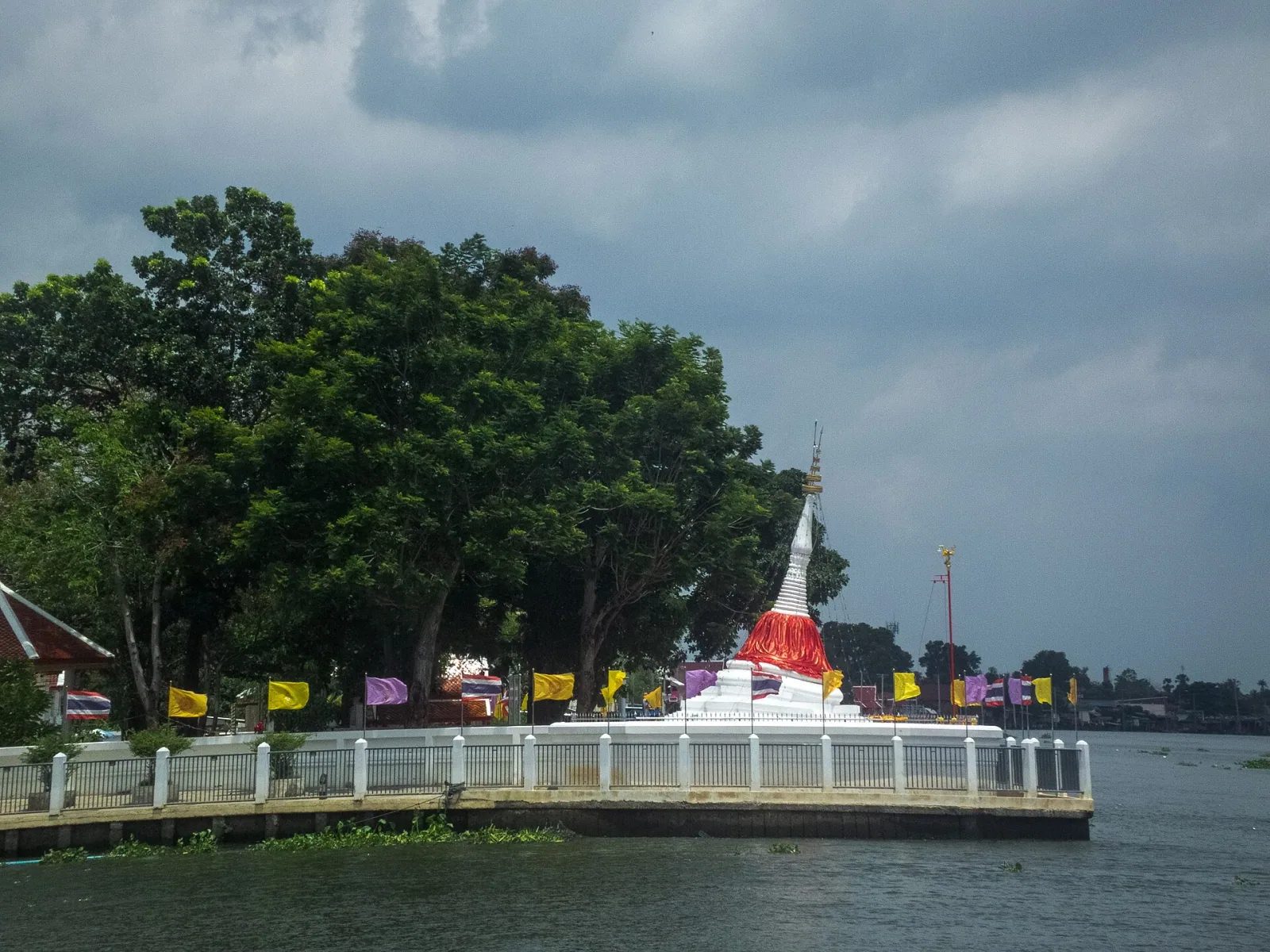
Ko Kret's emblem is the Phra Chedi Mutthao, a small white Mon-style stupa that leans noticeably toward the river behind Wat Poramaiyikawat—the island's principal temple, restored by King Rama V in the late 19th century. The wat houses a Mon-style ordination hall and a museum of Mon Buddhist texts and ritual objects. Around it, narrow lanes are lined with potters' workshops producing the unglazed terracotta water jars Ko Kret has been famous for since the Ayutthaya period; many studios sell directly, and a few offer hands-on workshops.
On weekends the island fills with a daytime market. Vendors set up along the loop trail selling Mon specialities—khao chae (chilled jasmine-scented rice eaten with savoury condiments, originally a Mon dish), tod mun pla (fish cakes), banana-leaf-wrapped sweets, hand-thrown pottery—plus the inevitable cold drinks and ice cream. It's busy but rarely overwhelming, and after about 4pm most stalls pack up and the island returns to its residents. Understanding the deeper context of Buddhism in Thai daily life helps frame Ko Kret's living-Mon-Buddhist traditions within Thailand's wider Theravada landscape.
Across the river in Bang Kruai, Wat Chaloem Phra Kiat Worawihan is the most striking of Nonthaburi's royal temples—a Rama III–era complex with white-and-Chinese-tile ornament, a wooden viharn, and a riverside terrace that draws photographers at sunset. Nearby Wat Sangkhathan is a working meditation centre that runs free residential retreats in Thai, and Wat Bot in Bang Kruai retains an old wooden bot with delicate gilt-on-black murals. None of these are tourist spectacles; they are everyday Thai Buddhist sites that you can simply walk into.
Everyone knows Damnoen Saduak in Ratchaburi—the floating market that appears on every coach-tour itinerary, where vendors pose for photos and prices reflect tourist rather than local economics. Nonthaburi keeps a quieter set of weekend markets that still function primarily for residents, without the manufactured atmosphere.
The most photographed is Bang Khu Wiang Floating Market, in Bang Kruai district. It runs from roughly 4am to 7am on weekends—monks paddle down the khlong on alms rounds at first light, vendor boats follow, and the whole thing is essentially over by the time most tourists are awake. Further west, Sai Noi Floating Market at Wat Sai Yai operates on weekends and public holidays in a wider, more relaxed form: vendor boats, riverside stalls, and a small Thai-style lunch crowd. Either is a better Saturday morning than Damnoen Saduak. Prices reflect local rather than tourist economics: fresh fruit 20–40 THB per kilo, boat noodles 30–50 THB per bowl, coconut pancakes (khanom krok) 20 THB for six pieces.
For canals beyond the markets, hire a long-tail at the pier (roughly 1,000–1,500 THB for 1–2 hours, split among passengers). The route takes you through narrow khlongs where houses overhang the water and wooden temples are still reachable only by boat. Add the cross-river ferry to Ko Kret on the same morning and you've put together a day on the water that costs less than a single mall lunch in central Bangkok.
Timing matters: Arrive by 8am when vendors are setting up and locals are shopping. After 10am, the tour groups start arriving and the atmosphere shifts from functional market to tourist attraction. By 11:30am most vendors pack up—floating markets operate on traditional schedules, not tourist convenience.
Bring cash: Small bills (20s, 50s, 100s) essential. Vendors don't accept cards, and breaking a 1,000 THB note for a 30 THB purchase creates awkwardness. ATMs exist near the market entrance.
Try the unusual: Beyond the tourist-friendly fruit and noodles, vendors sell fermented fish paste, insects, unfamiliar vegetables, and dishes that rarely appear in restaurants. This is where you encounter real Thai food culture, not the sanitized version served in expat areas.
The primary reason expats consider Nonthaburi is financial: rents typically run 20–35% below equivalent inner-Bangkok neighbourhoods while keeping reasonable access to the capital. A one-bedroom condo near a Purple Line station in Nonthaburi at 8,000–12,000 THB/month would cost 12,000–18,000 THB on the inner Sukhumvit line. Street food meals that cost 60–100 THB in touristy Bangkok areas cost 40–70 THB here. The monthly savings add up quickly—USD 400–700 difference for comparable lifestyle can mean the difference between Bangkok feeling financially stressful or sustainable.
But savings come with trade-offs that need honest assessment. The commute matters. From a Purple Line station in central Nonthaburi to Siam or Asok takes 50–70 minutes door-to-door, with a change at Tao Poon onto the MRT Blue Line. That's manageable—millions commute longer in major cities globally—but it's 50–70 minutes each way, well over an hour daily, around 10–12 hours weekly. For some people, the time trade-off for cost savings makes perfect sense. For others, living closer to work despite higher rent produces better quality of life.
The infrastructure equation factors heavily. Nonthaburi has plenty of modern condos with gyms, pools, and fibre internet (300 Mbps to 1 Gbps for roughly 500–700 THB monthly through AIS, True or 3BB). Healthcare access is solid—Bangkok Hospital has a branch in Mueang Nonthaburi, and several large public and private hospitals operate around the Ministry of Public Health complex on Tiwanon Road—though specialist conditions may still send you onward to Bangkok's major centres. Shopping ranges from local markets to Central Westgate (one of Thailand's largest malls, in Bang Yai). Specialty international groceries and the deeper end of Bangkok retail still mean periodic trips into the capital. Our guide to Thailand's healthcare system helps contextualise hospital options.
→ Rent (1BR condo, newer building): 10,000 THB – Modern unit with pool and gym, near an MRT Purple or Pink Line station
→ Utilities & internet: 1,800 THB – Electricity (AC-usage dependent), water, fibre internet
→ Food: 8,000 THB – Mix of street food (40–70 THB), local restaurants (80–150 THB), weekly supermarket
→ Transport: 1,500 THB – MRT trips into Bangkok, local motorcycle taxi, occasional Grab
→ Mobile & data: 500 THB – Unlimited data package for mobile hotspot backup
→ Recreation: 1,200 THB – Building gym, occasional Bangkok trips, weekend activities
→ Miscellaneous: 3,000 THB – Healthcare, shopping, unexpected expenses, savings buffer
→ TOTAL: 26,000 THB (~USD 725) comfortable living
Remote workers face a different calculation. If you're location-independent, the commute becomes irrelevant. Nonthaburi offers the same reliable fibre internet as Bangkok at lower cost in quieter surroundings. The lack of extensive co-working spaces matters less when your condo has good WiFi and a comfortable desk setup. You maintain easy access to Bangkok for social events, shopping, or healthcare while enjoying lower daily costs and genuine Thai community. Several cafés near MRT Purple Line stations and around Central Westgate accommodate laptop work with decent WiFi, though nothing approaching central Bangkok's café culture.
The cultural immersion in Nonthaburi is involuntary rather than optional. Unlike Bangkok's expat enclaves where you can live entirely in English-speaking bubbles, Nonthaburi maintains overwhelming Thai character. Your neighbors are Thai families, not fellow expats. The 7-Eleven clerk doesn't speak English. The motorcycle taxi driver communicates through gestures and Google Translate. Street signs are in Thai. Restaurant menus lack translations. You're not visiting Thailand—you're living in it.
For some people, this is precisely the appeal. You learn Thai faster through necessity than through language school classes in expat areas. You understand local culture through participation rather than observation. You develop genuine relationships with neighbors who've never considered you a temporary visitor but as someone who lives here. I've watched expats who struggled with Bangkok's expat scene thrive in Nonthaburi, finding the forced cultural adaptation more comfortable than navigating competitive expat social dynamics.
But forced immersion challenges others. If you need frequent English conversation, extensive Western food access, organized expat social events, and the support infrastructure that Bangkok's large foreign community provides, Nonthaburi will feel isolating. There are other foreigners here—teachers, retirees, people married to Thais—but no organized community, minimal international restaurants beyond basic pizza and burgers, and an assumption that if you choose to live here, you're adapting to Thai rather than Thai adapting to you.
The food situation exemplifies this dynamic. Nonthaburi offers excellent Thai cuisine at local prices—boat noodles, rice dishes, som tam, grilled fish from the river. Night markets provide variety, freshness, and prices that make Bangkok seem expensive. But international food beyond basic Western chains (KFC, McDonald's, Pizza Company) essentially doesn't exist. Craving Mexican? Drive to Bangkok. Need Indian spices? Bangkok trip. Want imported cheese? Also Bangkok. You can absolutely eat well in Nonthaburi, but you're eating Thai food 80-90% of the time unless you cook extensively at home with ingredients requiring Bangkok supermarket trips.
Perfect for: Bangkok commuters seeking cost savings, remote workers wanting a lived-in Thai neighbourhood near the capital, cultural enthusiasts comfortable with language barriers, those who prefer Thai community over expat scenes, people tired of inner-Sukhumvit intensity
Less suitable for: Those needing extensive English-speaking environments, people requiring diverse international dining, anyone uncomfortable with hour-plus door-to-door commutes into central Bangkok, expats wanting organised social scenes, travellers prioritising convenience over authenticity
Best approach: Spend a month here before committing long-term. Test the MRT commute to your Bangkok workplace during rush hour (07:00–09:00, 17:00–19:00). Assess whether the cost savings justify the additional transit time. Experience the cultural-immersion side to see if it suits how you actually want to live.
Any honest discussion of Nonthaburi must address flooding. The province sits on the Chao Phraya floodplain, crisscrossed by canals that provide drainage during normal conditions but overflow during heavy monsoon rains. The devastating 2011 floods affected significant portions of Nonthaburi, with water reaching 1-2 meters in some areas for weeks. While extensive flood prevention infrastructure has been built since then—improved drainage, flood walls, water management systems—the basic geography hasn't changed. Low-lying areas remain vulnerable during peak rainy season, especially September-October.
Newer condo developments are built with flood considerations—elevated ground floors, flood barriers, pump systems. Many buildings weathered the 2011 floods with minimal interior damage despite surrounding street flooding. But older areas along khlongs, particularly the traditional wooden house communities, accept periodic flooding as part of river life. Residents keep boats ready, elevate valuables, and adapt schedules around water levels. It's not apocalyptic disaster, but it is real inconvenience requiring contingency planning.
When considering accommodation, research the building's flood history and elevation. Properties near BTS stations in newer commercial areas generally sit higher and have better drainage. Riverside locations closer to old canal communities face higher risk. Your landlord or building management should be able to provide information about 2011 flood levels and what protections exist. It's not a reason to automatically avoid Nonthaburi, but it is a factor requiring realistic assessment. Bangkok faces similar risks—the entire region shares this geographic reality.
Nonthaburi is served by two metro lines and one express boat. The MRT Purple Line (opened 2016) runs 12 stations from Khlong Bang Phai in Bang Yai down through Bang Rak Yai, Sai Ma, Phra Nang Klao Bridge, Yaek Nonthaburi 1, Bang Krasor, Nonthaburi Civic Center and the Ministry of Public Health, then on to Tao Poon, where it interchanges with the MRT Blue Line into the centre. The MRT Pink Line (opened December 2023) runs east from Nonthaburi Civic Center through Pak Kret to Min Buri, intersecting the BTS Sukhumvit Line at Wat Phra Si Mahathat. Trains on both lines run roughly 06:00–24:00 at 5–10 minute peak headways. Krung Thep Aphiwat (Bang Sue Grand) Central Station—Bangkok's main long-distance rail hub since 2023—sits right on the Nonthaburi border and is one stop from Tao Poon on the Blue Line.
The Chao Phraya Express Boat uses Nonthaburi Pier (N30) as the northern terminus of its orange-, yellow-, and green-flag services into central Bangkok; it's the slower but more pleasant route and a serious draw for riverside residents. Within the province, motorcycle taxis (10–30 THB for short trips), songthaews on fixed routes (10–20 THB) and Grab (50–150 THB typical rides) cover the gaps. Many residents rent motorbikes—monthly 2,000–3,500 THB, daily 150–200 THB. Traffic is heavy but nowhere near central-Bangkok density. Thailand's helmet laws are enforced, and insurance becomes essential once you're riding regularly.
For airports: Don Mueang (DMK) is the closer of the two (~25 km, 30–45 minutes by car or taxi), with Suvarnabhumi (BKK) about 50 km away (60–90 minutes depending on traffic). Grab to Don Mueang typically runs 200–400 THB; to Suvarnabhumi 400–600 THB. Airport bus services exist but require changes. The proximity to Don Mueang makes weekend trips on AirAsia, Nok and Thai Lion particularly convenient—you can reach the airport faster from much of Nonthaburi than from inner Sukhumvit.
Nonthaburi experiences the same three-season pattern as Bangkok, with only marginal differences from being slightly inland. Cool season (November-February) brings pleasant temperatures (20-28°C), low humidity, and clear skies—ideal for exploring temples, floating markets, and outdoor activities. This is when the commute feels bearable, when evening walks along the river provide genuine enjoyment, and when you remember why you chose Thailand.
Hot season (March-May) tests your commitment with temperatures reaching 35-40°C and humidity making it feel hotter. Air conditioning shifts from comfort to necessity. Midday activities become unpleasant or impossible. The commute transforms into a sweltering ordeal if BTS trains are crowded. Long-term residents structure lives around the heat—errands in early morning, work indoors midday, resume activity only in evening. It's manageable but genuinely uncomfortable if you're heat-sensitive.
Rainy season (June-October) brings afternoon thunderstorms, moderate temperatures (26-32°C), and periodic flooding concerns in vulnerable areas. The rain isn't constant—typically sunny mornings with 2-4pm downpours that last 30 minutes to 2 hours. The BTS remains operational, but street-level flooding can make getting to/from stations complicated during heavy rain. Keep an umbrella and rain jacket handy, accept that some days you'll get soaked, and monitor weather forecasts during September-October when flooding risks peak.
Monthly Budget
~USD 725/month comfortable living
Savings: 20–35% lower overall costs than inner Sukhumvit
Rent: 8,000–12,000 THB vs 12,000–18,000 THB (1BR)
Food: 40–70 THB vs 60–100 THB per street meal
Transport: MRT + local ≈ 1,500 THB/month
To Siam (BTS): ~55 minutes from Nonthaburi Civic Center (Purple → Blue at Tao Poon, change to BTS)
To Asok: ~50 minutes, change at Sukhumvit (MRT Blue ↔ BTS)
To Bang Sue / Krung Thep Aphiwat: ~25 minutes, single change at Tao Poon
Operating hours: ~06:00–24:00 daily
Perfect for: Bangkok commuters, remote workers, cultural-immersion seekers, budget-conscious expats, those wanting a Thai neighbourhood near the capital
Less suitable for: English-dependent expats, those needing diverse international food, nightlife seekers, people uncomfortable with hour-plus commutes, flood-averse