Provinces
🎨Roi Et
Central Isan's lakeside city — home to one of Thailand's tallest standing Buddhas and the historic 'province of one hundred and one'
Central Isan's lakeside city — home to one of Thailand's tallest standing Buddhas and the historic 'province of one hundred and one'
You see the Buddha first from the city ring road—a 67-metre standing figure (59 m of statue on an 8-metre base) towering over the rooftops of Mueang Roi Et and visible from villages in three directions. Phra Phuttha Ratana Mongkon Maha Muni stands at Wat Burapha Phiram, among the tallest standing Buddha images in Thailand. Local farmers use it for navigation. Pilots mention it as a landmark. And for the roughly 1.28 million people of Isan's Roi Et province, it serves as spiritual anchor, source of pride, and reminder that this central-Isan capital holds something extraordinary at its centre.
The name "Roi Et" literally means "one hundred and one" — a traditional exaggeration of the city's historical eleven entry gates, talked up to a hundred and one to convey the old kingdom's reach. The province sits on the flat Khorat Plateau, drained by the Chi River (its largest watercourse) and the Yang. Mueang Roi Et itself is built around something rarer: Bueng Phlan Chai, a large artificial lake right in the centre of the city, with an island shrine, a clock-tower park, paddleboats, and an evening promenade that functions as Roi Et's living room.
This provincial capital—municipal population around 34,000, with the province at roughly 1.28 million—offers something increasingly difficult to find in Thailand: authenticity without isolation. You won't encounter backpackers or tour groups. English appears rarely beyond basic tourist signage at the main temples. International restaurants don't exist beyond a couple of mediocre attempts at Western food. Yet the city has adequate infrastructure—reliable internet, comfortable housing, varied Thai dining, hospitals handling routine care, and its own working airport—making it livable for remote workers who value cultural immersion over cosmopolitan convenience.
"Roi Et offers something increasingly difficult to find in Thailand: authenticity without isolation, culture without tourism, and affordability without sacrificing basic modern infrastructure."
Wat Burapha Phiram dominates Roi Et's identity in ways both literal and symbolic. The standing Buddha — Phra Phuttha Ratana Mongkon Maha Muni — measures 59.2 metres for the statue itself, or about 67.85 metres including the base, among the tallest standing Buddha images in Thailand. It represents classic Thai craftsmanship at impressive scale, the right hand raised in the gesture of granting protection. But what makes it remarkable isn't just size or artistry; it's how the statue functions as communal focal point for provincial life.
Sunrise at the temple is spectacular. The pale surface catches first light and seems to glow from within. Locals gather for morning alms-giving, monks receiving food offerings while the Buddha watches over the proceedings. The atmosphere is devotional but not solemn—families chat, children play near temple grounds, vendors sell breakfast to early risers. It's Buddhism as lived practice rather than tourist performance, accessible and genuine.
The temple sits just a short walk from Bueng Phlan Chai, and the two together form the social heart of the city. The lake's perimeter has pleasant walking paths, pavilions, food carts and exercise areas; in evenings the area becomes a social hub—couples stroll, families picnic, teenagers gather near food carts, and the Buddha visible above the rooftops makes a memorable backdrop. Living here means the standing Buddha becomes part of your daily landscape rather than a destination—you pass it commuting, see it from various neighbourhoods, use it for directions, and eventually take its presence for granted the way locals do.
Understanding Roi Et requires understanding Bueng Phlan Chai. The lake — created and reshaped over generations — sits in the geometric centre of the old city and is genuinely where Roi Et gathers. By dawn the paths around it fill with joggers, monks on alms rounds, and aerobics groups; by evening the same paths fill with families, teenagers and food vendors. The central island shrine, the clock tower, the paddleboats and the small lakeside zoo together make Bueng Phlan Chai feel less like a park and more like the city's outdoor living room.
The fresh markets are extraordinary. Chi River fish — varieties you won't find in tourist areas — appear fresh daily, incredibly affordable at 40-150 baht per kilogram. Grilled river fish becomes a dinner staple, served with sticky rice and Isan dipping sauces at restaurants throughout town. The freshness and quality spoil you for fish anywhere else. Food vendors around the night market grill catches direct from the morning market, selling plates for 60-100 baht that would cost triple in Bangkok and still not taste as good.
Roi Et is also one of the heartlands of khaen — the Isan free-reed mouth-organ — and the broader Isan musical tradition of mor lam. You'll hear it at temple fairs, weddings and the city's seasonal festivals, often with the deeply local rhythms of Isan folk dance. For visitors used to Thailand's beach-and-temple package, this living musical culture is one of the most distinctive things about the province.
Bueng Phlan Chai: The lake park is best visited at dawn or after sunset, when the heat is manageable and the place fills with locals. Paddleboat rental is cheap; the island shrine is free to visit.
Night market & lakeside dining: The night market by the lake runs roughly 5pm-11pm with the strongest scene on weekends. Order by pointing, specify grilling or steamed, and request spice level. Meals run 60-120 baht including sticky rice and vegetables.
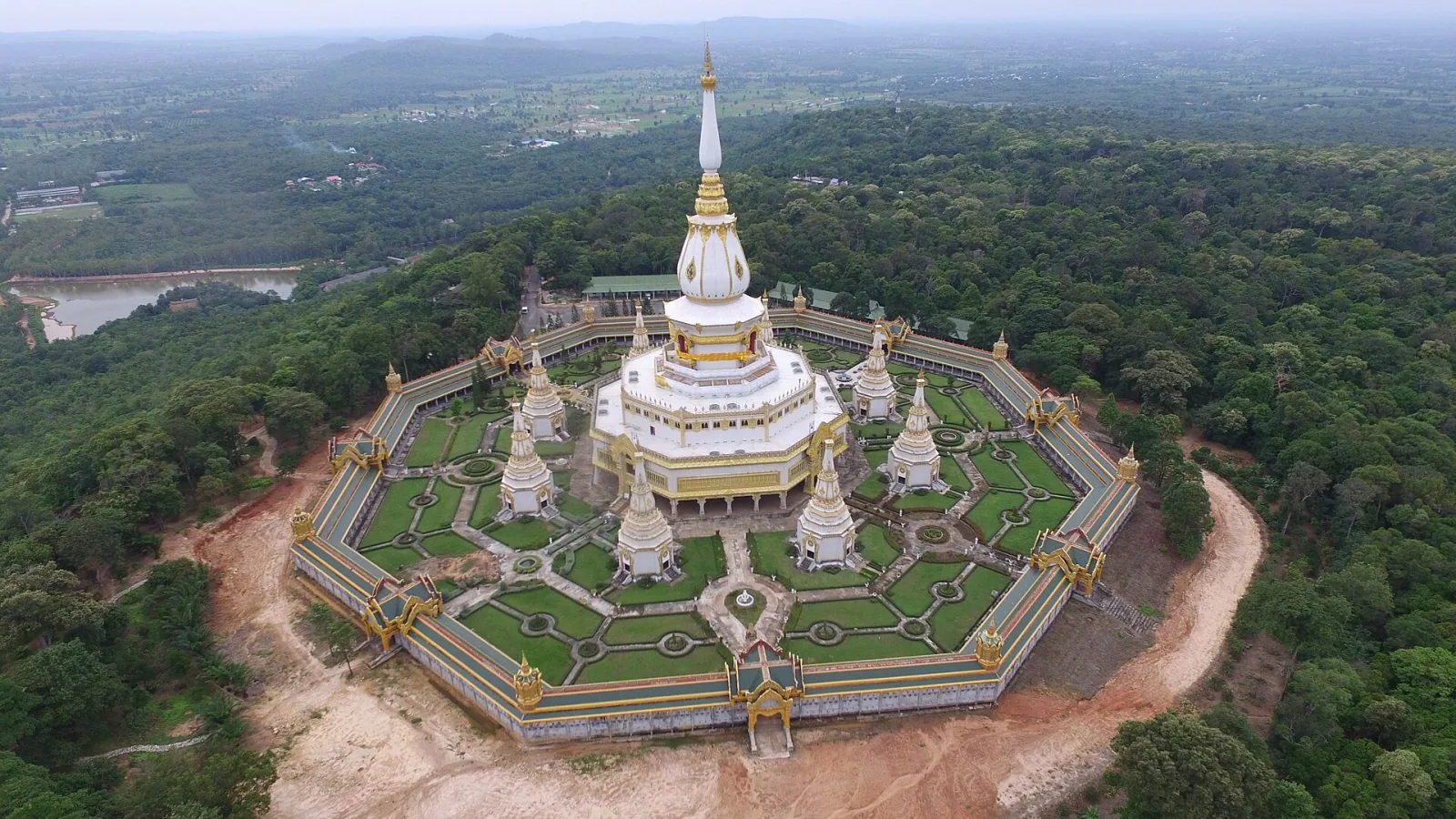
Phra Maha Chedi Chai Mongkol: The province's other great landmark, in Phon Thong district about 80 km north of the city — a striking white-and-gold pagoda set among hills, well worth a half-day trip from town.
Roi Et shares the silk weaving heritage common throughout Isan, with active mudmee textile production concentrated in Nong Phok and Selaphum districts to the east and northeast of the city. Family workshops continue traditional practices—raising silkworms, dyeing threads with natural materials, creating intricate patterns on wooden looms that have existed for generations.
Visiting these workshops reveals the remarkable skill involved. Mudmee technique requires tying sections of thread before dyeing, creating patterns that only emerge when fabric is woven. The weavers work from memory and experience, no written patterns, producing complex geometric designs through understanding built over lifetimes. Quality silk scarves range from 800-3,000 baht depending on intricacy and silk quality—wholesale prices reflecting genuine value rather than tourist markup.
The weaving communities appreciate visitors with genuine interest. They'll explain processes, demonstrate looming techniques, and discuss pattern meanings. Unlike tourist-oriented craft villages, there's no pressure to purchase, no staged demonstrations. These are working artisans who happen to welcome observers. For those interested in traditional Thai crafts and cultural preservation, Roi Et offers access to living traditions without commercial filtering.
The numbers make Roi Et compelling for budget-conscious remote workers. One-bedroom furnished apartments in the city center rent for 4,500-7,500 baht monthly—air conditioning, WiFi, hot water included. Street food runs 25-50 baht per meal. Local restaurants charge 40-100 baht for full plates. Markets sell fresh vegetables, fish, and meat at wholesale prices. A comfortable monthly budget—housing, food, utilities, transportation, modest entertainment—fits in 19,000-25,000 baht. This isn't backpacker hostel living; it's genuine middle-class Thai provincial life that happens to cost less than you'd spend for a week in tourist Thailand.
Internet connectivity suffices for remote work. Most apartments have fiber available running 500-700 baht monthly, speeds adequate for video calls and cloud work. Several cafes offer work-friendly environments with reliable WiFi and air conditioning. The peaceful atmosphere enables focused productivity—no bar noise, minimal traffic disruption, generally quiet evenings. The challenge isn't infrastructure but social isolation if you're accustomed to expat communities and English-language support.
Healthcare covers basic needs through Roi Et Hospital, which handles routine medical care, basic emergencies, and common illnesses. Doctor visits cost 400-800 baht without insurance. Pharmacies are accessible with affordable medications. For serious conditions or specialist care, you'll travel to Khon Kaen (about 115 km, ~1.5 hours) or Bangkok (~510-520 km). This reality shapes who can comfortably live here: generally healthy people comfortable with provincial medical facilities and willing to travel for complex needs.
→ Morning markets starting at 6am with fresh fish, vegetables, and prepared foods
→ Riverside walks and exercise areas becoming active around 5am and 5pm
→ Temple bells and chanting marking morning and evening transitions
→ Motorcycle-dominated traffic—cars are less common than two wheels
→ Evening markets and food stalls creating social gathering spaces
→ Virtually no English spoken outside basic tourist interactions
→ Buddhist calendar affecting business hours and alcohol sales during major holidays
Roi Et works brilliantly for remote workers with established income who value extreme affordability and cultural authenticity over convenience and nightlife. If your income comes from elsewhere and you can work independently without local job market access, the financial advantages are substantial. Your housing costs less than a week of Airbnb in Bangkok. Your food budget shrinks to a fraction of tourist-area prices while quality often improves. The savings compound quickly—within months you've built financial breathing room impossible in expensive locations.
It works for people genuinely interested in Isan culture, Buddhism, or traditional crafts. The silk weaving, temple life, river culture, and agricultural rhythms create rich opportunities for cultural learning. Unlike tourist areas where everything is curated for foreign consumption, Roi Et demands engagement on Thai terms. You either find that fascinating or frustrating—there's little middle ground.
It works for those comfortable with solitude and self-direction. The expat community is minimal—scattered long-term travelers and remote workers, no formal organizations or regular meetups. Social life requires either building relationships with Thai locals (language helpful) or being content with your own company. Some people find this liberating—freedom from expat social obligations, space for focused work or study. Others find it isolating.
But Roi Et struggles for anyone needing Western amenities, diverse international food, active nightlife, or English-language support. It struggles for people uncomfortable with deep cultural immersion or those expecting infrastructure matching tourist zones. There's no international school, no craft beer bar, no yoga studio with English instruction, no cinema showing Hollywood releases. The province offers authentic Isan life with basic modern infrastructure—excellent for those seeking exactly that, challenging for those expecting more.
While the standing Buddha draws initial attention, longer stays reveal Roi Et's deeper textures. Phra Maha Chedi Chai Mongkol in Phon Thong district, about 80 km north of the city, is the province's other great landmark — a vast white-and-gold pagoda set on a forested hill, with a meditation centre attached. The pilgrimage character is strong, the tour-bus presence almost nonexistent, and the surrounding rural Isan countryside is some of the prettiest in the province. Plan it as a half- or full-day trip from town.
The night market operates daily (5pm-11pm) with expanded weekend walking street, serving primarily local residents rather than visitors. Food stalls offer authentic Isan cuisine—Isan-style sukiyaki, grilled meats, multiple som tam variations, sticky rice specialties, and regional desserts at 30-100 baht per dish. Handicraft vendors sell woodcarvings, textiles, and local products at reasonable prices. Live music occasional weekends. The market represents genuine provincial commerce and social life—families shopping, teenagers hanging out, vendors gossiping between sales. It's where Roi Et gathers, making it essential for understanding local culture.
Day trips to surrounding villages reveal agricultural Isan unchanged by modernization. Rice fields stretch to horizons, farmers work with traditional methods supplemented by small tractors, village temples serve as social centers, and life follows patterns established generations ago. These aren't tourist attractions—they're just rural Thailand, accessible and welcoming if you approach respectfully. Many remote workers based in Roi Et spend weekends exploring surrounding districts, photographing landscapes, observing farming practices, and experiencing Thailand far removed from backpacker trails.
Choosing Roi Et means accepting trade-offs that don't work for everyone. You gain extraordinary affordability, authentic culture, peaceful atmosphere, and freedom from tourist infrastructure. You lose international amenities, English-language support, diverse dining options, and easy access to specialized services. The hot season (March-May) brings temperatures of 35-38°C that many find genuinely uncomfortable—this isn't Instagram sunset heat; it's productivity-sapping, sleep-disrupting intensity. Air conditioning becomes necessity, increasing electricity costs and reducing time spent outdoors.
The remoteness matters, but less than the article you may have read elsewhere suggests. Khon Kaen sits about 115 km away (~1.5 hours) for serious shopping or medical care. Bangkok is roughly 510-520 km (6-7 hours by road or an overnight bus). Roi Et has its own working airport (ROI) with daily flights to Bangkok Don Mueang on Nok Air, Thai AirAsia and Thai Lion — a real time-saver for anyone working remotely from here.
The language barrier is substantial. English appears rarely outside basic tourist signs at the standing Buddha and the lake park. Daily life—markets, healthcare, housing, services—happens entirely in Thai. Translation apps help but learning conversational Thai becomes practical necessity rather than cultural nicety. Some people find this motivating—immersive language environment accelerating learning. Others find it exhausting and limiting.
But for those whose priorities align with what Roi Et offers—affordability, authenticity, lakeside city life, Buddhist traditions, peaceful productivity, and freedom from tourism—few places in Thailand deliver better value. You're not compromising or settling; you're choosing different priorities. The standing Buddha watches over genuine Isan life rather than curated tourist experience. Bueng Phlan Chai is a working public space rather than a resort backdrop. The silk weavers produce for tradition and livelihood rather than performance. And your monthly expenses free resources for travel, savings, or simply breathing room in your budget. It won't work for everyone. But for those it works for, it works remarkably well. For insights on adjusting to provincial Thai life, see our guide on building community connections throughout Thailand.
KEY STATS
Population
~1.28 million
Monthly Budget
19,000-25,000 THB
Rent (1BR)
4,500-7,500 THB
Distance from Bangkok
~515 km (6-7 hours)
BEST FOR
HIGHLIGHTS
Remember
Roi Et demands full cultural engagement. English is virtually absent, Thai food dominates, and authentic Isan life surrounds you completely. Perfect for deep immersion, challenging for those expecting Western comforts or expat communities.
PROS
CONS
From Bangkok
Bus: 8-10 hours, 280-450 THB
Car: 6-7 hours via Highway 2
Airport
Roi Et (ROI) — daily flights to Bangkok Don Mueang on Nok Air, Thai AirAsia, Thai Lion