Provinces
🏖️Songkhla Province
Southern Thailand's Cultural Crossroads
Southern Thailand's Cultural Crossroads
The Golden Mermaid statue sits on a rock at Samila Beach, her bronze form turned toward the Gulf of Thailand, as she has for decades. Local legend says she was a princess who died waiting for her fisherman lover to return from the sea. These days, young couples take selfies with her while Thai families spread mats on the sand for evening picnics. Behind the beach, the narrow peninsula holds Songkhla's Old Town—a maze of Sino-Portuguese shophouses painted in fading pastels, Chinese shrines fragrant with incense, and coffee shops that have served the same families for three generations. This is Songkhla: a province where Thai-Buddhist, Chinese, and Malay-Muslim cultures have intertwined for centuries, creating something distinct and authentic that most travelers rushing between Bangkok and the islands never discover.
Songkhla province sprawls across Southern Thailand's narrow peninsula, encompassing the historic city of Mueang Songkhla, the bustling commercial hub of Hat Yai, and landscapes ranging from pristine beaches to mountainous inland areas. The province's geography is defined by Songkhla Lake, Thailand's largest natural lake system, which stretches across three provinces and supports fishing communities that have worked these waters for generations. The provincial capital sits on a slender peninsula between the lake and the gulf, giving it a unique dual waterfront character—sunrise over the lake, sunset over the sea, with the city sandwiched beautifully between.
For centuries, Songkhla served as a crucial trading port connecting the Thai kingdoms with China, Malaysia, and the wider Maritime Southeast Asia. Chinese merchants arrived in waves during the 18th and 19th centuries, building ornate temples and the distinctive Sino-Portuguese shophouses that still line the Old Town's streets. Malay-Muslim communities established themselves, contributing Islamic architecture and culinary traditions. Thai-Buddhist culture formed the foundation, with hilltop temples commanding the skyline. Unlike more touristy provinces, Songkhla hasn't been scrubbed clean and repackaged for foreign visitors—it remains a working city where authentic Southern Thai life continues largely as it has for generations. For insights into Southern Thai culture, see our guide to Thai holidays and festivals.
Safety advisory: Songkhla's four southern districts
The four southern districts of Songkhla — Chana, Thepha, Nathawi and Saba Yoi — are part of the area affected by the Southern Thailand insurgency and have been under a standing Emergency Decree in force since July 2005, renewed quarterly by the cabinet. The UK FCDO and US State Department advise against all but essential travel to these four districts, alongside Pattani, Yala and Narathiwat. Songkhla city, Hat Yai, Sadao and Padang Besar (the main visitor and transit areas covered in this guide) sit outside that advisory area, but the regional security situation is real — check the latest FCDO and US State Department advisories before travelling and avoid the four districts above unless you have a specific reason to be there.
"Songkhla remains a working city where authentic Southern Thai life continues largely as it has for generations—Chinese New Year celebrations fill the Old Town, fishing boats still depart at dawn, and three cultures share the same streets with remarkable harmony."
Samila Beach curves for two kilometers along the gulf, its golden sand shaded by pine trees and its promenade popular with evening strollers. The famous Golden Mermaid statue, created by Prince Chumbhot Paribatra in the 1960s, has become the city's symbol—you'll see her image on everything from government buildings to restaurant signs. The beach isn't the pristine, resort-lined affair you'll find on Thailand's tourist islands. Instead, it's authentically local: Thai families gathering for weekend picnics, street food vendors grilling seafood, young couples riding tandem bicycles, elderly Chinese-Thai men practicing tai chi at dawn.
Just offshore sit Ko Nu and Ko Maew—Mouse Island and Cat Island—two small rocky outcrops that become especially photogenic at sunset when the light turns golden and fishing boats silhouette against the sky. The beach comes alive in the evenings and on weekends when local markets appear with vendors selling everything from grilled squid to traditional Southern Thai sweets. Unlike more famous Thai beaches, Samila offers something increasingly rare: a beach experience shaped by local life rather than tourist expectations.
The Old Town preserves what much of Southern Thailand looked like a century ago—before modernization swept away most historical architecture. Colorful Sino-Portuguese shophouses line narrow streets, their facades showing the architectural style that emerged when Chinese merchants built homes combining Chinese design elements with Portuguese colonial influences. The compact grid of Nakhon Nai, Nakhon Nok and Nang Ngam roads — the latter the focus of the city's street-art trail — has been restored over the past decade as part of a sustained bid to enter Thailand's UNESCO World Heritage tentative list. Some shophouses have been converted into cafés and small museums; others remain family homes and shops, their interiors little changed from when they were built.
Chinese shrines appear throughout the Old Town, alongside the principal historic temple Wat Matchimawat (Wat Klang) — founded in the late Ayutthaya period and largely rebuilt under King Rama IV. The ordination hall holds an exceptional set of Rattanakosin-era murals depicting Songkhla life, and a small temple museum next door holds Sukhothai and Ayutthaya bronzes alongside Sino-Thai trade ceramics. During Chinese New Year, the Old Town explodes with celebrations: lion dances, firecrackers, temple fairs and street markets showcasing the vitality of Songkhla's Chinese-Thai community.
Street art has appeared in recent years, with murals depicting local history, fishing culture, and daily life. The Songkhla National Museum, housed in a beautiful 19th-century Chinese-style mansion, showcases Southern Thai culture, archaeology from the ancient Srivijaya period, and exhibits on the region's multicultural heritage. The building itself is worth visiting—a masterpiece of Sino-Thai architecture with intricate details and period furniture that transport you to an era when Chinese merchants dominated Southern Thai commerce.
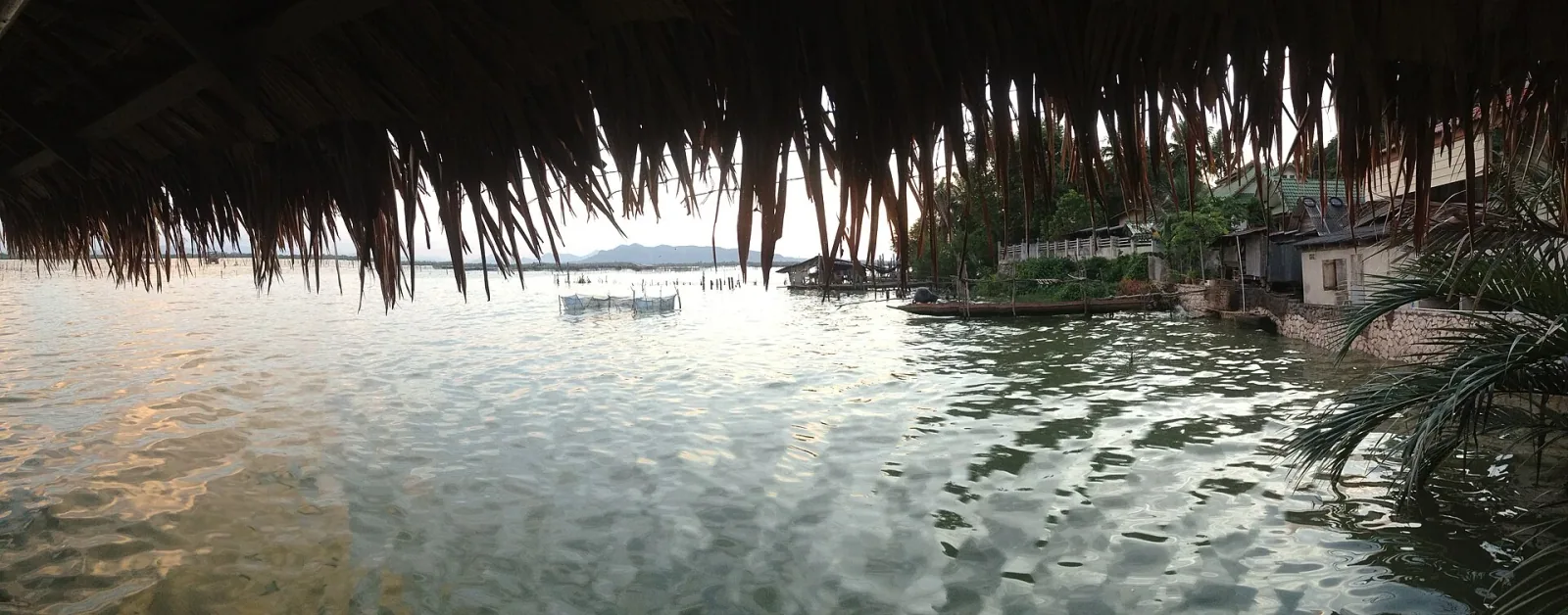
Songkhla Lake stretches vast and shallow, Thailand's largest natural lake, supporting ecosystems that have evolved over millennia. Boat tours take you to lake-edge fishing villages where families have worked these waters for generations. The province's well-known prehistoric rock-art site sits up the eastern coast at Khao Khuha in Rattaphum district, where cave overhangs have yielded ancient pottery and burials. Bird-watchers head north into Phatthalung to the Thale Noi reserve at the lake's top end, internationally important for waterfowl. At dawn, the lake turns silver, fishing boats creating dark silhouettes against the glowing water, an image that feels timeless.
For panoramic views from Songkhla city itself, head up Khao Tang Kuan — the white chedi atop the peninsula's central ridge, reachable by stairs or a short funicular. The summit gives the classic dual view: Songkhla Lake on one side, the Gulf of Thailand on the other, the Old Town spread along the strip between. Hat Yai has its own equivalent: Hat Yai Municipal Park, where a long dragon-flanked staircase (or a cable car) climbs to the giant standing Phra Buddha Mongkol Maharaj image — the city's signature sunset spot.
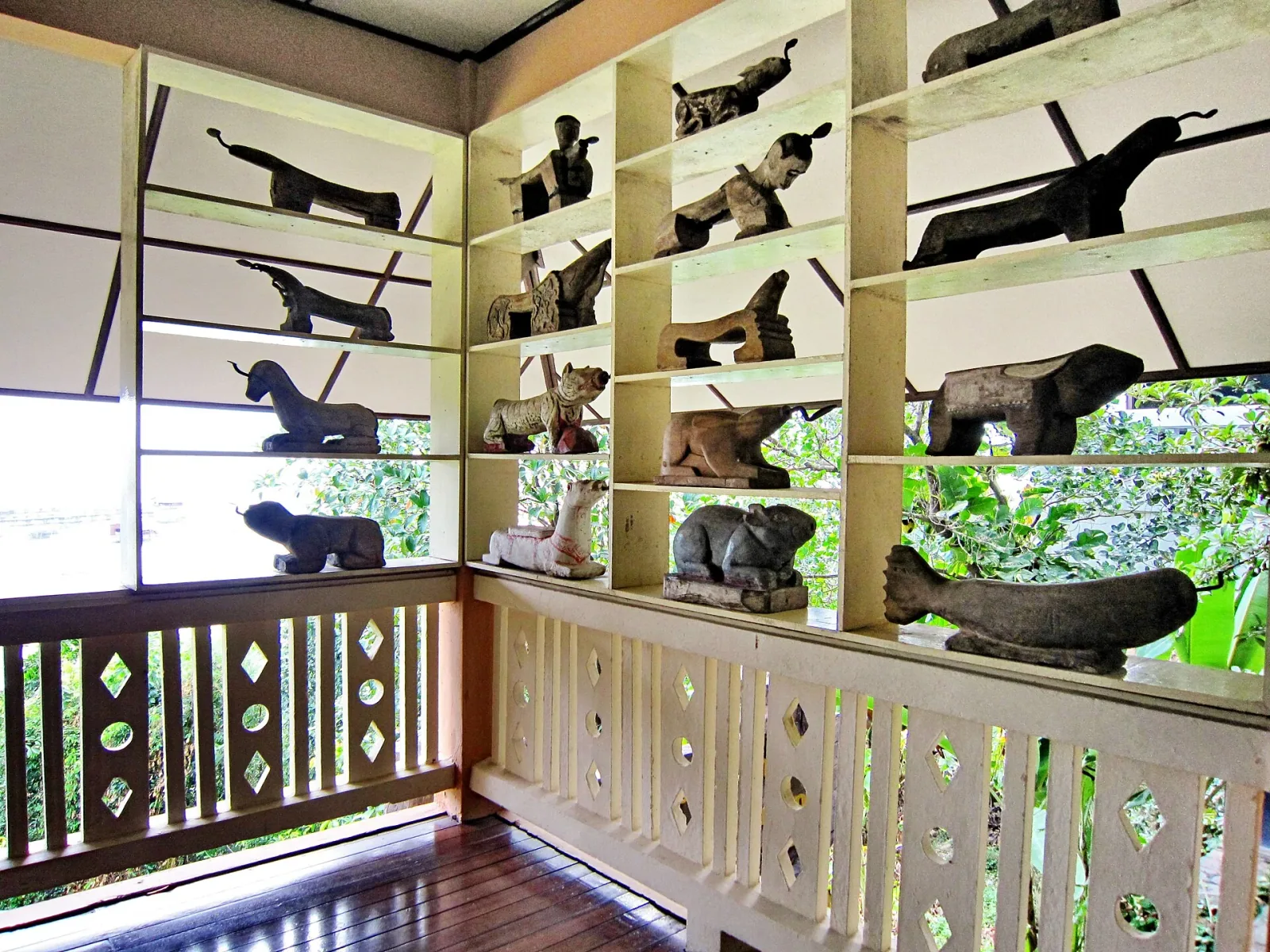
Songkhla's cultural identity reflects the reality that Southern Thailand has always been a crossroads. Chinese New Year brings massive celebrations in the Old Town—lion dances weaving through streets, firecrackers creating explosive cascades of sound, temple fairs where vendors sell everything from roasted chestnuts to traditional Chinese medicine. The Thai-Buddhist Chak Phra Festival in October features elaborate boat processions on Songkhla Lake, decorated vessels carrying Buddha images in a spectacle that's been repeated for centuries. Malay-Muslim communities contribute their own traditions, mosques calling the faithful to prayer, halal restaurants serving roti and curry, Islamic architecture adding another layer to the city's visual diversity.
What's remarkable is how these communities coexist without the friction you might expect. Buddhist temples, Chinese shrines, and mosques share the same neighborhoods. Festivals from all three traditions are celebrated city-wide, not just within their respective communities. The cuisine blends Thai, Chinese, and Malay influences so thoroughly that determining where one tradition ends and another begins becomes impossible. This multiculturalism isn't performative diversity for tourists—it's the lived reality of a place where different peoples have shared space long enough that their boundaries have blurred.
Songkhla's cuisine will challenge anyone who thinks they know Thai food from restaurants back home. Southern Thai cooking emphasizes powerful, uncompromising flavors—extremely spicy, intensely sour, deeply aromatic in ways that Central Thai cuisine tones down for broader appeal. The province's multicultural heritage creates fusion dishes that blur the lines between Thai, Chinese, and Malay culinary traditions. Fresh seafood from both the gulf and the lake dominates menus, prepared in ways that showcase rather than mask the ocean's briny intensity.
Kua kling—that intensely spicy dry curry with minced pork or beef—represents Southern Thai cooking at its most uncompromising. Kaeng som, a sour and spicy soup with fish and vegetables, appears at breakfast tables throughout the region. You'll encounter sataw pad goong, stir-fried stink beans with shrimp, an acquired taste that locals love and visitors find either fascinating or overwhelming. Fresh seafood gets grilled simply—squid, fish, crab, prawns—with the day's catch displayed on ice for you to choose from before it hits the charcoal. For a deeper dive into Thai food culture, see our guide to food costs in Thailand.
The Samila Beach night market offers the most concentrated food experience—seafood grills sending smoke and aroma across the sand, local snacks displayed in rainbow arrays, Southern specialties you won't find in Bangkok. The Old Town's Nakhon Nok Road preserves traditional coffee shops serving dim sum and local bakery items alongside strong Thai coffee. Morning markets throughout the city operate from dawn to mid-morning, the best time for authentic Southern breakfast dishes before the heat becomes oppressive. Muslim restaurants around mosque areas serve roti mataba, halal curries, and Malay-influenced dishes that bridge Thailand and Malaysia culinarily.
→ Southern Thai food is genuinely spicy—when locals say "spicy," they mean it. Start with "pet nit noi" (a little spicy) and work your way up.
→ Seafood is fresh daily but check prices first—tourist areas charge more than local spots.
→ Morning markets (6-10am) offer the most authentic and affordable food experiences.
→ Chinese-Thai coffee shops serve strong kopi and traditional breakfast; perfect for slow mornings.
→ Kaeng tai pla (fermented fish kidney curry) is an acquired taste even for Thais—approach cautiously.
Most travelers arrive via Hat Yai International Airport, just 30 kilometres from Songkhla city. Daily flights from Bangkok take about 90 minutes, while international connections serve Malaysia, Singapore, and (intermittently) China. From the airport, grab a taxi or van (300-400 baht) or take a local bus into Hat Yai city and transfer to Songkhla-bound transport for cheaper travel. Overland options include VIP buses from Bangkok's Southern Bus Terminal — roughly 950 km, ~13-14 hours overnight — or overnight sleepers from Krung Thep Aphiwat (Bang Sue Grand), which replaced Hua Lamphong as Bangkok's main long-distance rail hub in 2023, to Hat Yai Junction. Hat Yai is also Thailand's southern rail node, with onward branches to Padang Besar (the rail border with Malaysia, with through-trains to Butterworth and Kuala Lumpur) and Sungai Kolok. Drivers heading to Malaysia have two land crossings: Sadao / Dan Nok (the busiest land border in the country by trade volume) and the smaller Padang Besar crossing.
Within Songkhla city, songthaew shared pickup trucks run set routes for 10-30 baht—different colors cover different areas, though figuring out the system requires asking locals or trial and error. Motorcycle taxis offer quick trips for 20-50 baht; drivers wear colored vests and congregate at designated spots. The Old Town is compact enough for walking or cycling—some guesthouses rent bicycles for 50-100 baht daily, perfect for exploring the historic streets at a leisurely pace. For broader exploration, motorbike rentals (200-300 baht per day) give you freedom to discover beaches, temples, and lakeside areas on your own schedule.
Accommodation ranges from budget guesthouses in the Old Town (500-800 baht) offering basic fan rooms with historical charm, to mid-range hotels like BP Samila Beach Hotel (800-2,000 baht) with modern amenities and sea views, to upscale options like Pavilion Songkhla Hotel (2,000-4,000 baht) with pools and spa facilities. Book ahead during Chinese New Year and the October Chak Phra Festival when rooms fill quickly. Many hotels offer significant discounts for monthly stays if you're planning extended time in the area. For remote workers and longer stays, check out our guide to working remotely from Thailand.
"Songkhla offers something rare in modern Thailand—a genuine working city where tourism supplements rather than dominates the economy, where locals outnumber visitors, and where cultural authenticity hasn't been sacrificed to mass tourism."
Songkhla works beautifully for travelers seeking authentic Thai experiences beyond the well-worn tourist trail. The province offers cultural depth—three distinct communities sharing space harmoniously, historic architecture preserved rather than reconstructed, festivals celebrated by locals rather than performed for tourists. It works for food enthusiasts willing to embrace genuinely spicy Southern Thai cuisine. It works for those who appreciate beaches shaped by local life rather than resort development. The province pairs naturally with Hat Yai's transport hub and onward travel to Phatthalung, Trang and Malaysia — but the southern districts (Chana, Thepha, Nathawi, Saba Yoi) and the neighbouring provinces of Pattani, Yala and Narathiwat sit under active travel advisories and are not casual day-trip territory.
Digital nomads will find Songkhla less equipped than Chiang Mai or Bangkok but workable. Internet is reliable in most accommodations, a growing cafe culture in the Old Town provides work-friendly spaces, and the relatively low cost of living (15,000-25,000 baht monthly for comfortable lifestyle) makes extended stays financially viable. The small but welcoming expat community consists mostly of teachers and long-term residents rather than short-term digital nomads. English is limited outside Hat Yai and tourist areas, so learning some Thai becomes more important here than in more international cities.
The best time to visit falls between December and March, when rainfall drops and temperatures become somewhat more bearable, though "cool" is relative—expect 27-34°C. The hot season from April to June pushes temperatures toward 36°C with high humidity, manageable if you embrace the afternoon siesta culture. The wettest months, November and December, bring the northeast monsoon's full force with heavy rainfall and possible flooding in low-lying areas. Time your visit for Chinese New Year (January/February) to witness the Old Town's celebrations, or October for the spectacular Chak Phra boat processions on the lake.
Songkhla sits at a cultural and geographical crossroads—30 kilometres from Hat Yai's urban energy, close enough to the Malaysian border at Sadao and Padang Besar that overland trips into Penang or Kuala Lumpur are straightforward. Pattani is just over 100 kilometres south but sits inside the Deep South advisory area — visit it as a considered choice rather than a casual day trip. Songkhla offers accessibility without sacrificing authenticity, infrastructure without overwhelming commercialization, and a glimpse of Southern Thai life that most travelers miss entirely as they rush between Bangkok and the islands. The Golden Mermaid still gazes out at the gulf, families still spread mats on Samila Beach for evening picnics, and the Old Town's shophouses still glow in their faded pastels as the sun sets. Songkhla isn't trying to be the next big tourist destination. It's simply being itself—which might be exactly what you're looking for.
Population
~1.4 million (province)
Language
Thai (Southern dialect), Malay, Chinese
Culture
Thai-Chinese-Malay fusion
Best Time
December-March (dry season)
Getting There
Hat Yai Airport → 30min drive
Key Attractions
Chinese New Year: Lion dances, firecrackers, temple fairs in Old Town (Jan/Feb)
Chak Phra: Spectacular boat processions on the lake (October)
Nang Talung: Traditional shadow puppet theater at temples and festivals