Provinces
🐘Surin Province
Where elephants and silk define Thailand's cultural heritage
Where elephants and silk define Thailand's cultural heritage
The first time I watched an elephant bathe itself in Surin—genuinely bathe itself, not performing for tourists but simply enjoying a river on a hot afternoon—I finally understood the difference between seeing elephants and being in elephant country. Surin Province, pressed against Cambodia in Thailand's northeastern corner, has sustained relationships with elephants for centuries. Here, the Kui people have passed down elephant knowledge through generations, creating a bond between humans and animals that predates tourism by hundreds of years.
But Surin is more than elephants, though they dominate its international reputation. This is also one of Thailand's most important silk-weaving regions, where villages such as Ban Tha Sawang and Khwao Sinarin still weave on hand looms using Khmer-derived patterns. It is a province of sandstone Khmer temples, Northern Khmer- and Kuy-speaking communities along the Cambodian border, and Isan food so intensely flavoured that Bangkok's versions taste like pale imitations. And it does all of this while staying cheap enough that a single person can live comfortably on 14,000–22,000 baht a month.
Unlike neighboring Buriram with its archaeological focus, Surin presents a living cultural landscape. The elephants aren't historical artifacts; they're integrated into communities. The silk weavers aren't museum demonstrations; they're producing textiles for sale and sustaining family traditions. This is Thailand at its most authentically northeastern—less polished than tourist destinations, more rewarding if you approach with patience and genuine interest.
"This is Thailand at its most authentically northeastern—less polished than tourist destinations, more rewarding if you approach with patience and genuine interest."
Surin's elephant story is complex, sometimes uncomfortable, and increasingly focused on ethical tourism rather than exploitation. The province's Kuy (or Suay) people—an ethnic minority with their own Mon–Khmer language and customs—have traditionally worked as elephant mahouts. For centuries, elephants provided labour in logging and agriculture. When Thailand banned logging in 1989, an estimated three thousand domesticated elephants and their mahouts lost their primary livelihood. Some turned to street begging in Bangkok and tourist shows. Others found better paths.
Today the focal point is Ban Ta Klang, an hour north of Surin city, where the government-supported Elephant Study Centre and the Lek Chailert–founded Surin Project work with Kuy mahout families on sanctuary-style care. Visitors watch elephants behaving naturally—grazing, playing in water, interacting with family groups—and mahouts explain elephant behaviour, demonstrate training techniques that rely on trust rather than force, and discuss the challenges of caring for animals that live well into their fifties and need hundreds of kilos of food a day.
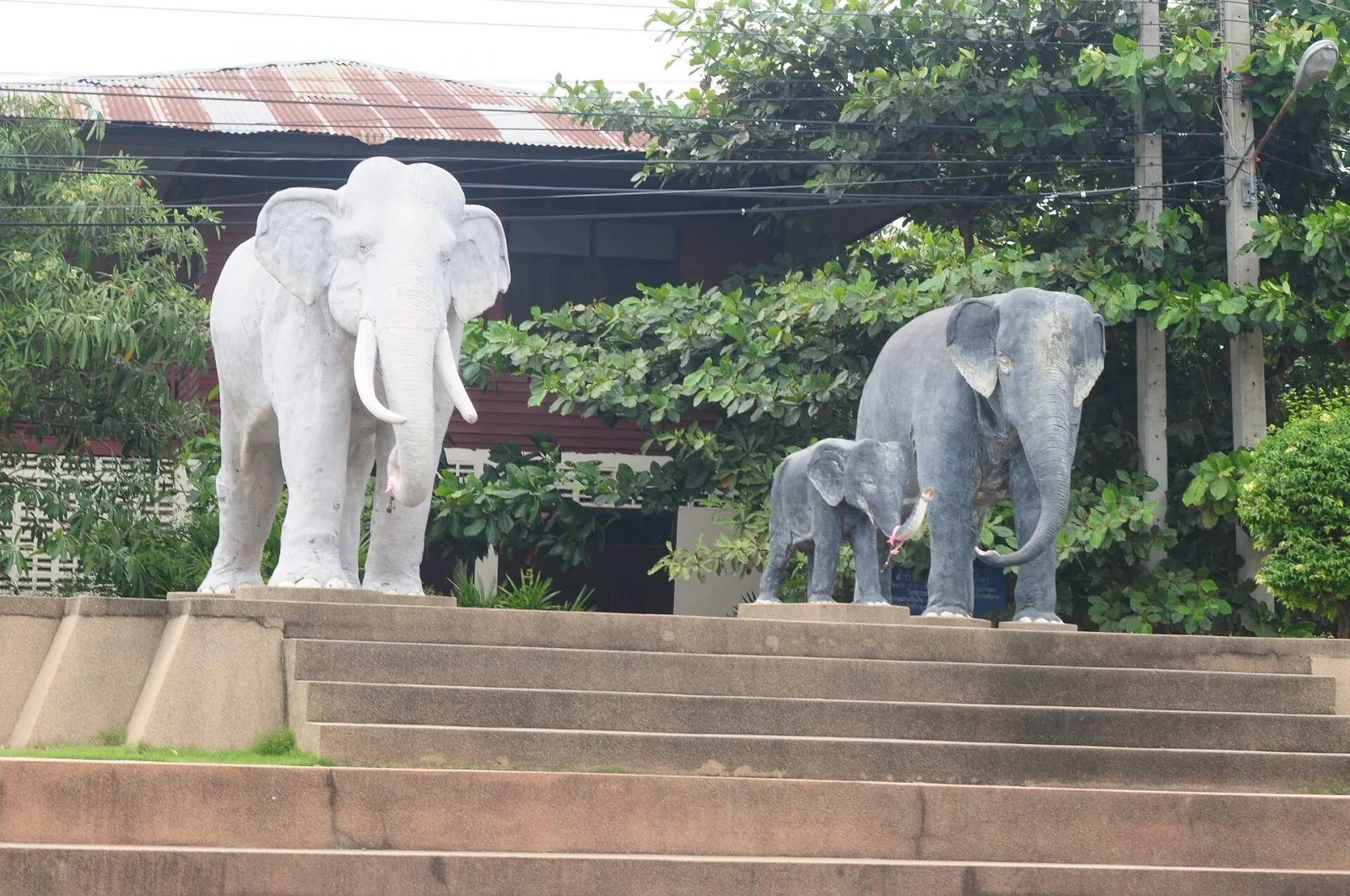
Be honest with yourself about elephant tourism. Even the best sanctuaries involve some level of human intervention in elephant lives. The genuinely ethical operations prioritize elephant welfare, employ knowledgeable mahouts from traditional elephant-keeping families, provide substantial natural habitat, and focus on education rather than entertainment. Book directly with sanctuaries, ask detailed questions about their practices, and be prepared to pay fair prices—ethical elephant care isn't cheap, nor should it be.
The Surin Elephant Round-Up, held on the third weekend of November, is the province's most famous event—and its most contested. More than two hundred elephants parade through town, take part in displays of traditional elephant work, and join staged battle re-enactments. The festival has gradually shifted toward more educational content, but international animal-welfare organisations continue to flag concerns; treat it as cultural documentation rather than uncritical entertainment.
While elephants grab headlines, Surin's silk-weaving traditions deserve equal attention. Ban Tha Sawang, about ten kilometres north-west of Surin city, is famous for pha yok thong—an extraordinarily fine gold- and silver-thread brocade once commissioned for the Thai royal court—and a full piece can take four weavers months to finish. Khwao Sinarin, twelve kilometres east of the city, pairs silk weaving with traditional silversmithing. Walk through either village on a weekday morning and you'll hear the rhythmic clacking of wooden looms from nearly every house, with master weavers (mostly women, though some men weave) running patterns from memory.
The process is entirely manual. Silk threads are dyed using natural pigments—indigo for blues, tamarind for golds, lac insects for reds. Patterns are created through tie-dyeing (the mat-mi, or mudmee, technique) before weaving, requiring meticulous planning. Surin's signature pattern is pha hol, a Khmer-derived weft ikat in earthy reds, browns and yellows. A single piece of complex silk might take weeks to complete. Watching someone weave, you understand why quality Thai silk commands high prices—it isn't inflated tourist pricing but fair compensation for skilled, labour-intensive work.
Many weavers welcome visitors. Knock politely, express interest (even broken Thai helps enormously), and most will gladly demonstrate their work. Purchase directly from weavers when possible—you'll pay 500-2,000 baht for pieces that would cost three times that in Bangkok shops, and the money goes directly to artisans rather than middlemen. Treat these interactions as cultural exchanges, not shopping expeditions. The weavers are preserving traditions that predate modern Thailand, and they're doing it in an economy that often undervalues handcraft in favor of factory production.
Surin city itself is unexceptional—a provincial capital with markets, shops, a bus station, and residential neighborhoods that exist entirely for local needs rather than tourist convenience. This is precisely its appeal. Living costs in Surin are almost comically low by international standards. Studio apartments run 3,000-6,000 baht monthly. One-bedroom places with air conditioning cost 4,000-7,500 baht. Street food meals are 25-50 baht. Restaurant meals rarely exceed 150 baht unless you're ordering extravagantly.
The morning market explodes into life before dawn, with vendors spreading out produce, prepared foods, sticky rice, grilled meats, and regional specialties. Shopping here requires pointing, smiling, and basic Thai vocabulary—English is essentially nonexistent. But the experience is wonderful precisely because of this authenticity. You're not a tourist being accommodated; you're a person participating in daily provincial life. Vendors might give you extra fruit, explain how to eat unfamiliar vegetables, or invite you to sample their curry. The market isn't performing culture for visitors; it's culture happening naturally, and you're fortunate to witness it.
Isan food in Surin hits harder than anywhere else I've experienced. Som tam (papaya salad) comes with proper fermented fish sauce, creating a pungent, funky, addictively delicious flavor profile. Larb (minced meat salad) balances sour, spicy, and herbal notes with precision. Sticky rice accompanies everything—you eat it with your hands, using it to scoop and absorb flavors. Grilled river fish, forest vegetables, bamboo shoots, and tropical fruits provide variety. The cuisine reflects agricultural abundance and Khmer influences from across the nearby border.
Studio apartment (city center): 3,000-6,000 THB
Utilities (electric, water, internet): 500-800 THB
Food (markets, street stalls, occasional restaurants): 4,000-6,500 THB
Transportation (motorcycle rental or songthaew): 1,000-2,000 THB
Elephant sanctuary visits and cultural activities: 2,000-3,000 THB
Social, entertainment, miscellaneous: 1,500-2,500 THB
Total: 14,000-22,000 THB/month (~$400-$630 USD)
Surin is not a hill-tribe province in the northern Thai sense—it sits in the lowland Khorat Plateau, not the highlands. Its ethnic distinctiveness comes from the Cambodian border: roughly half of the population speaks Northern Khmer at home, alongside large communities of Kuy (Suay) elephant-keepers and Lao Isan speakers. Each group keeps its own dialect, weaving and culinary traditions, often within the same district. The result is the most linguistically Khmer province in Thailand outside Sa Kaeo and Buriram.
The ethical approach to visiting these communities is the same as anywhere else: hire local guides, ask permission before photographing people, purchase crafts directly from artisans at fair prices, and treat communities with the same respect you'd want in your own hometown. The best experiences come through co-operatives that work directly with weaving and silversmithing households and ensure income stays local. For broader context on Thai cultural traditions, our guides offer essential background.
Surin shares the Khmer architectural heritage visible throughout this border region. Prasat Sikhoraphum, in Sikhoraphum district roughly 30 km east of Surin city, is the province's most significant temple—an early 12th-century Khmer complex of five brick-and-sandstone prangs on a single laterite platform, with a famous Shiva Nataraja lintel above the central doorway. Smaller but equally atmospheric is Prasat Ban Phluang, an unfinished 11th-century sanctuary in Prasat district. Both sit alongside the older Khmer royal road that once connected Angkor to the temples of the Khorat Plateau, and both remain relatively unvisited.
The temples connect Surin to the broader Khmer Empire that once dominated this region. Carving styles, architectural techniques and iconography here flow directly into Cambodia's Angkor sites a few hours away. The third major Surin Khmer site, the Prasat Ta Muean temple complex on the Cambodian border in Phanom Dong Rak district, has been at the centre of the renewed Thai–Cambodian border dispute that flared into armed clashes in July 2025 and again later in the year; check the current situation before attempting to visit, and assume the surrounding land border crossings may be closed or restricted.
→ Elephants living in communities rather than zoos or shows
→ Silk weavers demonstrating centuries-old techniques in village homes
→ Morning markets where you're the only foreigner and that's perfectly normal
→ Hill tribe communities maintaining distinct cultural identities
→ Khmer temples you'll explore virtually alone
→ Monthly costs that make long-term stays financially feasible
→ Isan food so intensely flavorful it redefines Thai cuisine in your mind
Let's be direct about Surin's challenges. English is rare outside of a handful of elephant tourism operations. Western amenities are minimal. Entertainment consists of what you create—exploring villages, eating street food, befriending locals, perhaps teaching English at schools desperate for native speakers. Healthcare exists at a basic provincial hospital level, but serious medical issues require trips to Khon Kaen or Bangkok. Internet reliability varies significantly—fine for email and basic work, questionable for video calls or large file transfers.
The expat community is tiny—maybe a few dozen Westerners, primarily teachers, retirees married to locals, and the occasional remote worker drawn by low costs. You won't find expat social clubs or international restaurants. You will find, if you make the effort, warm welcomes from Thai communities who appreciate foreigners genuinely interested in their culture. Learning Thai isn't optional in Surin; it's essential for anything beyond surface-level tourism. Even basic conversational Thai transforms your experience from isolated observer to participant in daily life.
Finding accommodation relies primarily on Facebook groups, walking around neighborhoods looking for rental signs, or asking guesthouse owners for long-term connections. The rental process is informal—you might sign a simple contract or just shake hands and pay monthly. Most places come basically furnished. Air conditioning is standard. Expect minimal lease terms, month-to-month arrangements common, and landlords who speak little to no English but communicate effectively through Google Translate and patience.
Transportation centres on motorcycles—rent one for 1,500–2,500 baht monthly and you have the freedom to explore silk villages, elephant sanctuaries, and temple ruins at your own pace. Songthaews (shared pickup taxis) handle in-town transport for 20–40 baht per ride. Surin railway station sits on the Bangkok–Ubon Ratchathani Northeastern Line; since 2023 the main long-distance Bangkok departure point has been Krung Thep Aphiwat (Bang Sue Grand), and direct trains take roughly seven to eight hours. There is no airport in Surin itself—the nearest are Buriram (BFV, ~64 km west, with daily flights to Bangkok Don Mueang) and Ubon Ratchathani (UBP, ~170 km east). For visa extensions, be prepared for immigration offices with limited English and bring all required documents meticulously prepared.
"You're choosing provincial life over easy access to modern conveniences. For some, that sounds like deprivation. For others, it sounds like relief from tourism's relentless commercialization."
Surin works for specific types of people. Animal lovers interested in ethical elephant experiences will find Surin's sanctuaries more authentic than tourist-heavy operations in Chiang Mai or Pattaya. Cultural enthusiasts fascinated by traditional crafts, ethnic diversity, and living heritage rather than museum displays will thrive here. Budget-conscious expats and retirees seeking minimal living costs in an authentic Thai environment often discover Surin suits them perfectly. Remote workers whose jobs genuinely allow location independence and don't demand high-speed connectivity can live comfortably here for fractions of what Bangkok or Western cities cost.
It doesn't work for everyone. If you need regular flights, extensive English services, Western restaurants, or active nightlife, Surin will frustrate you. If you're not prepared to engage deeply with Thai culture and language, the isolation becomes oppressive rather than charming. If you require reliable high-speed internet for work, verify your specific location's connectivity carefully before committing. And be honest about elephant tourism—even the best sanctuaries involve complex ethical considerations.
Teaching opportunities exist at local schools, typically paying 25,000-35,000 baht monthly—enough to live very comfortably in Surin with surplus for savings or travel. Schools are often desperate for native English speakers and may be flexible about qualifications, though legitimate teaching positions require proper work permits and credentials. This can provide not just income but deep community integration, forcing you to engage with Thai society beyond tourist interactions.
Surin sits close to the Cambodian border. The Chong Chom crossing in Kap Choeng district has historically been an easy onward route, but the renewed Thai–Cambodian border dispute in 2025 has led to closures and restrictions at several land crossings in this sector—check the current Thai immigration and FCDO/US State Department advisories before relying on it. Neighbouring Buriram Province lies about 50 km west and is home to the spectacular Phanom Rung historical park—Thailand's most complete Khmer hill-top temple and currently on the UNESCO World Heritage tentative list (not yet inscribed). Nakhon Ratchasima (Korat), the largest city in Isan, is about three and a half hours west; Khon Kaen, four hours north, is the region's main university and medical hub and a useful fallback for international hospitals and visa matters.
What keeps drawing me back to Surin, despite easier options elsewhere in Thailand, is its refusal to become anything other than itself. The elephants aren't tourist attractions first and living animals second—they're elephants living in communities that have sustained them for centuries, with tourism as one income source among many. The silk weavers aren't performing culture for cameras; they're producing textiles using the methods their grandmothers taught them, methods that will hopefully pass to another generation. The food isn't adjusted for foreign palates—it's Isan cuisine at full intensity, take it or leave it. For travelers exhausted by tourist Thailand's relentless commercialization and seeking something more genuine, more challenging, and infinitely more rewarding, Surin offers experiences you simply can't find in Phuket or Bangkok. And it offers them at costs that make extended stays financially feasible for people who couldn't otherwise afford long-term travel. That combination—authenticity and affordability—is increasingly rare in Southeast Asia, and it makes Surin worth its challenges.
ESSENTIALS
Population
~1.39 million (2024)
Region
Northeast (Isan)
Monthly Budget
14,000-22,000 THB
Studio Rent
3,000-6,000 THB
BEST FOR
• Ethical elephant experiences
• Cultural immersion seekers
• Craft & textile enthusiasts
• Budget-conscious expats
CLIMATE
Ban Ta Klang Elephant Village
Kuy mahout community & study centre
Ban Tha Sawang & Khwao Sinarin
Silk-weaving and silversmithing villages
Prasat Sikhoraphum
Early 12th-c. Khmer five-prang temple
Prasat Ban Phluang
Unfinished 11th-c. Khmer sanctuary
Prasat Ta Muean Thom
Border temple — check current situation
Phanom Sawai Forest Park
Quiet viewpoints south of the city
From Bangkok
Train (Krung Thep Aphiwat): ~7–8 hrs
Bus (Mo Chit): ~7–8 hrs, 500–800 THB
Nearest airports
Buriram (BFV): ~64 km west
Ubon Ratchathani (UBP): ~170 km east
Local Transport
Motorcycle: 1,500–2,500 THB/month
Songthaew: 20–40 THB/ride
→ Choose sanctuaries focused on observation, not rides
→ Buy silk directly from village weavers
→ Ask permission before photographing people
→ Hire local guides for hill tribe visits
→ Support communities, not exploitative tourism