Provinces
🏞️Uthai Thani Province
Central Thailand's quietest province — Sakae Krang floating houses, the UNESCO-listed Huai Kha Khaeng, and Wat Tha Sung's Crystal Castle
Central Thailand's quietest province — Sakae Krang floating houses, the UNESCO-listed Huai Kha Khaeng, and Wat Tha Sung's Crystal Castle
A row of teak raft houses bob gently on the Sakae Krang, their wooden walkways creaking as locals carry breakfast bowls back to floating kitchens. A few hundred kilometres of forest to the west, a ranger checks a camera trap in some of Southeast Asia's most important tiger habitat. You're three hours from Bangkok, in Uthai Thani Province — a quiet corner of Central Thailand that most travellers skip on the way north and that, for exactly that reason, has preserved something rare.
Uthai Thani is officially part of Central Thailand (often grouped with the Lower North) and sits on the Chao Phraya basin's western edge. The province covers about 6,730 square kilometres and is defined by two things: the Sakae Krang River, a calm 225-kilometre lowland tributary of the Chao Phraya that runs through the city, and the vast Huai Kha Khaeng Wildlife Sanctuary, a UNESCO World Heritage site inscribed in 1991 (jointly with Thungyai Naresuan) and home to tigers, leopards, banteng, and one of mainland Southeast Asia's largest tracts of intact forest.
Uthai Thani City, the provincial capital of about 16,000, sits peacefully on the riverbank. This is a working Central Thai river town where life proceeds according to seasons and river levels, and where the floating raft houses and floating fish farms moored along the Sakae Krang are still genuinely working homes — not a tourist installation. For travellers seeking authentic provincial Thailand and a serious wildlife-conservation story, Uthai Thani offers something increasingly rare: a province that has been mostly left alone.
"Uthai Thani is a province that has been mostly left alone — floating houses on a quiet river, a Crystal Castle temple just outside town, and one of Southeast Asia's most important wildlife sanctuaries an hour to the west."
The Sakae Krang is not a whitewater river. It's a placid lowland waterway that meanders through the centre of Uthai Thani city before joining the Chao Phraya, and its defining feature is the long line of traditional floating raft houses moored along the banks — wooden one- and two-storey homes built on bamboo and barrel floats, many of them also operating as floating fish farms. Some families have lived this way for generations. You can wander the city-side promenade and watch daily life unfold across the water, or take a slow long-tail tour for a few hundred baht.
The river is best explored at a slow pace: gentle long-tail boat trips (a few hundred baht for a couple of hours), stand-up paddleboarding through calm reaches, and morning walks along the riverside park. A few small operators rent kayaks for flat-water paddling, but anyone expecting Class III rapids or limestone-canyon adventure should look to other parts of Thailand — that's not what the Sakae Krang is.
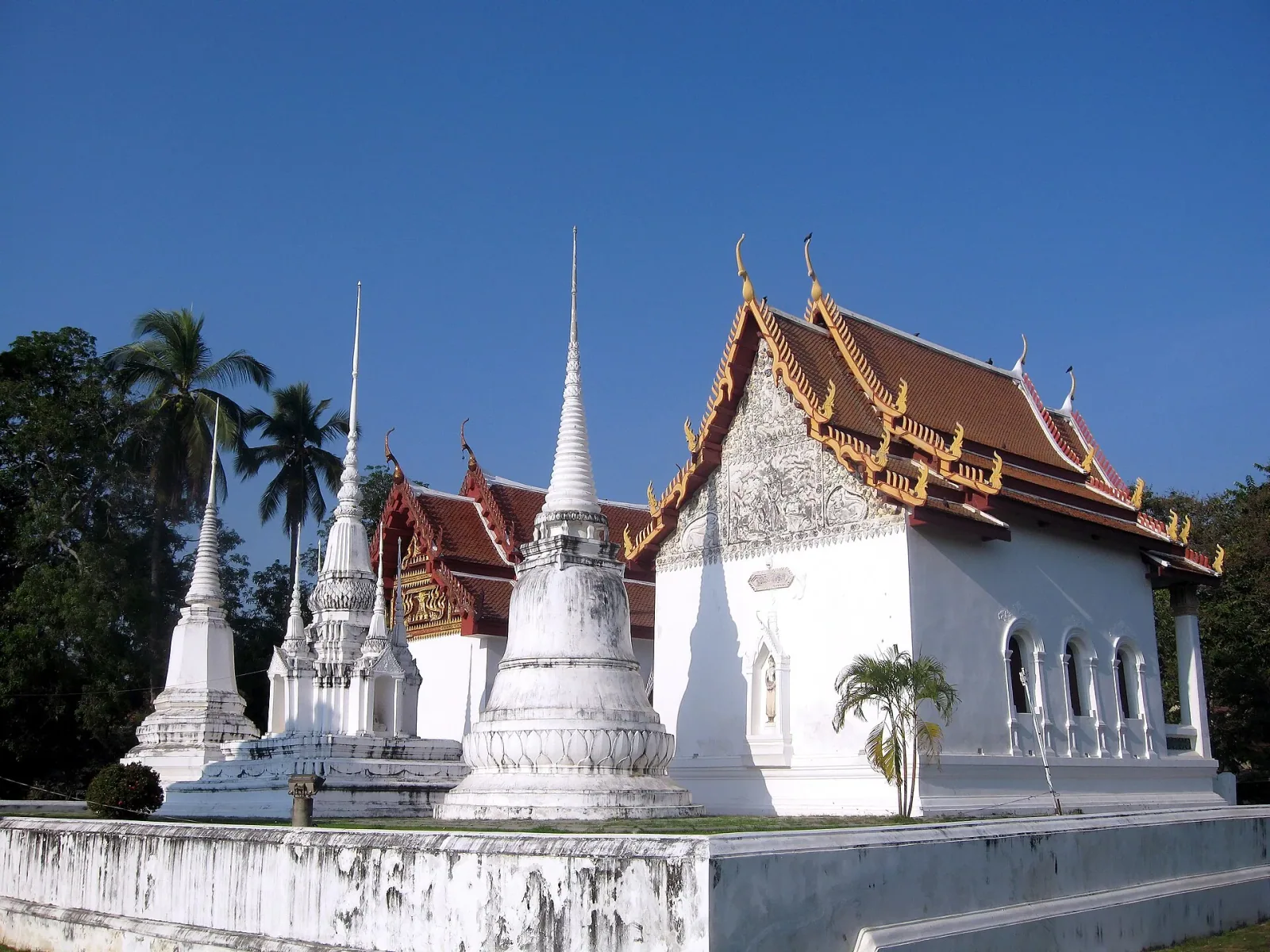
The other landmark on the river is Wat Sangkat Rattana Khiri, perched on top of Khao Sakae Krang hill just behind the town. The climb up the stairs (a few hundred steps, but doable) ends with sweeping views over Uthai Thani's roofs, the river, and the surrounding rice plains — especially good at dawn. Just outside the city, Wat Tha Sung (also called Wat Chantharam) is the province's most photogenic temple: its multi-storey Vihara Kaew, the "Crystal Castle," is clad floor-to-ceiling in mirrored glass mosaic, an unusual sight even by Thai temple standards.
Huai Kha Khaeng Wildlife Sanctuary covers roughly 2,780 square kilometres of primary forest west of the city — one of Thailand's most important conservation areas and, jointly with Thungyai Naresuan to the west, a UNESCO World Heritage site (inscribed 1991). This is serious wilderness: tigers, leopards, elephants, banteng, gaur, and over 350 recorded bird species. It is one of the last places in mainland Southeast Asia where a viable tiger population still hunts wild prey across a contiguous landscape.
The sanctuary's identity is inseparable from Seub Nakhasathien, the ranger and chief of Huai Kha Khaeng who took his own life at the headquarters in September 1990 in protest at the deforestation and illegal logging he could not stop. His death galvanised Thai conservation and led directly to the sanctuary's World Heritage inscription a year later. The Seub Nakhasathien Foundation still operates in his name, and a small memorial and museum at the headquarters give visitors a sober introduction to what is at stake here.
Access is strictly controlled. Most of the sanctuary is closed to casual visitors; the small visitor zone around the headquarters has a museum, a memorial, short walking trails, and a viewpoint. For deeper visits, contact the Department of National Parks (DNP) office in advance — permits, accompanied ranger trips, and overnight stays at the headquarters are arranged through them, not through commercial tour operators. The reward for a respectful visit is access to a landscape almost untouched by mass tourism, with a conservation story unlike anywhere else in Thailand.
From Bangkok: Minivans from Mo Chit (Northern Bus Terminal) take roughly 3-3.5 hours for 150-250 THB. Direct buses also operate (3.5-4 hours, 120-200 THB). There is no commercial airport in Uthai Thani; the nearest is Phitsanulok (about 180 km north) or Bangkok itself.
From Chiang Mai: 6-7 hours by road via Tak and Kamphaeng Phet (Highway 1). Scenic but long; many travellers break the trip in Sukhothai.
Local transport: The city centre is small and walkable. Rent a scooter (2,000-2,500 THB/month) to reach Wat Tha Sung, Hup Pa Tat sinkhole forest, and the Huai Kha Khaeng visitor zone. Long-tail boat tours of the Sakae Krang run a few hundred baht for a couple of hours.
Uthai Thani City maintains the character of authentic provincial Thailand. Wooden shophouses line the riverside, their second floors often serving as family homes while the ground level operates as small shops or restaurants. The morning market (5-10am) brings out vendors selling river fish, wild mushrooms collected from forest, vegetables grown in riverside gardens. This isn't a tourist market—you'll hear Thai exclusively, see cooking techniques passed through generations, and navigate crowds of locals doing their weekly shopping.
Wat Tha Sung, a short scooter ride out of town, is the temple visitors talk about: the mirrored Crystal Castle (Vihara Kaew) is genuinely unusual, and the surrounding compound includes a vast assembly hall, a long covered walkway, and free vegetarian food at lunchtime offered by the temple. Closer to the centre, Wat Sangkat sits on Khao Sakae Krang hill above the town with views across to the river plain — locals climb it for evening exercise and for the dawn views. For deeper insights into Buddhist practices in daily Thai life, explore our cultural guides.
Several small cafes along the river cater to the modest flow of visitors and remote workers. These aren't Chiang Mai-style digital nomad hubs but simple riverside places with decent WiFi, good Thai coffee, and menus heavy on local dishes. The owners often double as informal tourist information, helping visitors arrange boat tours, transport to Huai Kha Khaeng, and homestays in surrounding villages.
Uthai Thani's cost of living falls somewhere between Bangkok's expense and rural provinces' extreme affordability. One-bedroom apartments near the river run 8,000-12,000 baht monthly. Small houses with gardens cost 10,000-18,000 baht. Utilities add 1,200-1,800 baht depending on air conditioning use. Internet is adequate—fiber available in town for 300-500 baht monthly, though speeds lag behind major cities.
Food costs remain very reasonable. Street food meals run 35-65 baht. Restaurants serving local specialties—river fish, wild mushroom curry, som tam with regional variations—charge 60-120 baht for complete meals. The morning market offers produce at prices that make cooking attractive: vegetables for 10-30 baht per kilo, river fish for 100-200 baht that feeds two or three people, wild-collected mushrooms during rainy season for 150-250 baht per kilo.
What Uthai Thani offers cheaply is access to the genuinely quiet things — long-tail boat tours on the river for a few hundred baht, scooter rentals for the day, free or low-cost temple visits, and the modest entrance fees at Huai Kha Khaeng's visitor zone. Weekend trips to Hup Pa Tat sinkhole forest, the floating raft houses, or Wat Tha Sung cost almost nothing. The province is not set up for high-adrenaline adventure tourism — but for slow exploration of central-Thai countryside, the economics are excellent.
→ Rent (1-bedroom near river): 8,000-12,000 THB
→ Utilities (electricity, water, internet): 1,500-2,000 THB
→ Food (local meals + market cooking): 6,000-8,000 THB
→ Scooter rental: 2,000-2,500 THB/month
→ Day trips (boat tours, Huai Kha Khaeng, temples): 1,000-3,000 THB
→ Miscellaneous: 1,500-2,500 THB
Total: roughly 20,000-30,000 THB ($550-820) for a comfortable provincial lifestyle
The foreign presence in Uthai Thani is small — a scattering of remote workers, retirees, and people connected to the conservation community at Huai Kha Khaeng. There's no organised expat social scene, no weekly meetups, and no infrastructure designed for foreign residents. You'll build community informally — through cafe regulars, Thai neighbours, and shared interests — rather than through formal organisations.
English is rare outside guesthouses catering to adventure travelers. Medical care is basic—provincial hospital handles routine issues, but serious problems require the three-hour trip to Bangkok or evacuation by helicopter in emergencies. International restaurants don't exist; you'll eat Thai food or cook your own. Entertainment consists of outdoor activities, riverside cafes, and occasional live music at local bars. If you need variety, stimulation from urban amenities, or ready access to international services, Uthai Thani will feel limiting.
Internet reliability can be challenging during peak hours or storms. Video calls work but sometimes require patience and backup mobile hotspots. Co-working spaces don't exist—you'll work from your apartment, guesthouses, or cafes that welcome laptop users. For digital nomads whose work demands perfect connectivity and backup infrastructure, Uthai Thani might cause stress. For those with flexible schedules who can shift work around occasional outages, it's manageable.
"Uthai Thani trades urban convenience for quiet provincial life and access to one of Thailand's most important wildlife sanctuaries. You'll need flexibility, basic Thai skills, and a tolerance for slow."
Travellers who genuinely love Uthai Thani share a temperament rather than a hobby: they value slowness, they're comfortable in places that don't perform for visitors, and they'd rather spend a Saturday on a long-tail boat watching kingfishers than in a mall. They're also comfortable with basic living conditions — simple accommodation, limited international dining, infrastructure that occasionally fails.
Remote workers occasionally choose Uthai Thani over Chiang Mai or Bangkok specifically because the small-town quiet helps them concentrate, and because the cost of living is roughly half of Bangkok's at every line item. Anyone interested in conservation, wildlife photography, or the Seub Nakhasathien legacy at Huai Kha Khaeng will also find more substance here than in most provincial capitals.
Visitors on longer trips often base themselves here for weeks at a time, using Uthai Thani as a quiet centre for exploring nearby Nakhon Sawan, Chai Nat, and Kamphaeng Phet. The combination of affordable accommodation, easy bus access to Bangkok, and the wildlife-conservation calendar at Huai Kha Khaeng makes it practical as a base for slow regional travel. The small foreign presence means you quickly become known — cafe owners save your usual table, a sense of belonging develops faster than in anonymous larger cities.
November through February brings ideal conditions — 18-28°C, clear skies, comfortable river-side mornings. This is the season most people visit, and the only time when Huai Kha Khaeng's access roads are reliably passable. December and January mornings can feel genuinely cold by Thai standards; locals wear jackets, and you'll appreciate long sleeves before sunrise.
March through May turns hot and dry, with daytime highs of 35-38°C and occasional spikes higher. Many residents shift activity to early morning and evening. The rainy season (June-October) brings afternoon thunderstorms, lush green countryside, and dramatic skies; the river rises, the forest comes alive, and access to parts of Huai Kha Khaeng becomes difficult. September-October sees the heaviest rainfall but also the most spectacular landscapes.
Uthai Thani appeals to a specific kind of visitor — those who measure a place by quiet, slowness, and substance rather than restaurant variety or nightlife. This isn't Thailand for everyone, and that's precisely what makes it work for those who fit.
What it offers is increasingly rare: a Central Thai river town that hasn't been remade for tourism, the Crystal Castle and hilltop pagoda within easy reach, the country's most important tiger sanctuary an hour to the west, and a conservation story (Seub Nakhasathien, the Foundation, the UNESCO inscription) that gives the visit weight beyond sightseeing.
If you need to ask whether Uthai Thani suits you, it probably doesn't. But if you're drawn to slow river towns, if you value substance and conservation context over instagram backdrops, if you find satisfaction in a temple with a mirrored hall and a sanctuary where rangers still walk patrols for tigers — Uthai Thani might be exactly what you're seeking. At minimum, spend three or four days. Walk the riverside at dawn. Visit Wat Tha Sung. Spend a morning at the Huai Kha Khaeng visitor zone and the Seub Nakhasathien memorial. Then decide whether you want to come back. For more on slower provincial Thailand, explore our guides to different regions of Thailand.
Provincial Capital
Uthai Thani City
Population
~320,000 (province)
Distance from Bangkok
~230 km north-northwest
Main Attractions
Sakae Krang floating houses, Huai Kha Khaeng (UNESCO), Wat Tha Sung
BEST FOR
NOT IDEAL FOR
Emergency Numbers
Sakae Krang Floating Raft Houses
Wander the city-side promenade or take a long-tail tour
Huai Kha Khaeng Wildlife Sanctuary
UNESCO World Heritage tiger country; visit the Seub Nakhasathien memorial
Wat Tha Sung (Crystal Castle)
Mirrored Vihara Kaew, a short ride from town
Wat Sangkat Rattana Khiri
Hilltop temple above the city for dawn views
Hup Pa Tat Sinkhole Forest
Lush sunken karst forest in Lan Sak district