Provinces
🏔️Yala Province
Thailand's southernmost point: where three cultures create something entirely unique
Thailand's southernmost point: where three cultures create something entirely unique
In December, when the rest of tropical Thailand swelters in humidity, something improbable happens in Betong: nighttime temperatures slip into the high teens to low twenties. Locals pull out sweaters they keep in closets all year. The Betong Winter Flower Garden fills with tulips, roses, hydrangeas and chrysanthemums you won't see growing elsewhere in Thailand. Chinese grandmothers walk through morning markets in light jackets, speaking Hokkien and Mandarin while haggling over Malaysian imports and Thai vegetables. This is Betong district—a mountain salient jutting south into Malaysia and bordered by it on three sides—creating a cultural island where Chinese-Thai traditions flourish in Thailand's southernmost province.
Yala Province stretches across 4,521 square kilometers of Thailand's Deep South, its western mountains rising into rainforest while eastern plains roll toward the sea. The provincial capital, Mueang Yala, pulses with Malay-Muslim life—mosques dominating skylines, markets conducting business in Pattani Malay dialect, Islamic call to prayer marking the day's rhythm. Then there's Betong, the southernmost district roughly 140 kilometers south of Yala city, where Chinese culture has evolved in relative isolation for generations, creating fusion found nowhere else in the Kingdom.
This is Thailand's most culturally complex province, a place where over 70% of the population is ethnic Malay-Muslim, maintaining traditions distinct from mainstream Thai society, while pockets like Betong preserve Chinese heritage through language, food, and festivals that feel transported from another country entirely. Buddhist temples, Islamic mosques, and Chinese shrines exist within blocks of each other, each serving communities that define themselves as much by ethnicity and religion as by Thai nationality.
Yala is part of Thailand's Deep South, where an active Malay-Muslim separatist insurgency has killed roughly 7,000 people since January 2004. An Emergency Decree has been continuously in force across the province since 19 July 2005, renewed every three months, and martial law applies across most districts. Regular shootings, IED attacks, and arson incidents continue to be reported.
Government advisories: The UK FCDO advises against all but essential travel to the whole of Yala Province. The US State Department issues a Level 3 "Reconsider Travel" advisory for Yala, Pattani, Narathiwat, and southern Songkhla. Australia, Canada, and most EU governments mirror this advice. Travelling against your government's advice will likely invalidate your travel insurance.
Lower-risk areas (relatively): Betong district is generally considered the calmest part of Yala due to its predominantly Chinese-Thai population and isolated geography, though it remains under the Emergency Decree. Yala city centre sees domestic tourism. Both are still in the conflict zone.
Higher-risk areas: Rural districts, especially after dark. Secondary roads between towns. The Hat Yai–Padang Besar / Sungai Kolok rail line through Yala, which the FCDO specifically advises against. Border areas outside official crossings.
If you go anyway: Read your government's current advisory in full. Register with your embassy. Confirm whether your insurer will cover you. Use experienced local guides. Stay in Yala city or Betong. Travel only during daylight hours on main highways. Maintain high situational awareness.
"Yala offers experiences found nowhere else in Thailand—temperate flowers blooming in Betong's December gardens, Malay satay next to Chinese dim sum, Islamic calls to prayer echoing across mountain valleys. But it demands something in return: cultural sensitivity, real security awareness, and willingness to embrace complexity without simple answers."
Geography made Betong unusual. The district occupies a mountain salient that protrudes south into Malaysia, bordered by Perak to the south and Kedah to the west, with only a narrow corridor of Thai territory connecting it to the rest of Yala to the north—to reach it you drive south from Yala city through winding mountain roads that climb into rainforest before dropping into this pocket of land that geography suggests might belong to Malaysia but history decided would be Thailand. This relative isolation produced something remarkable: a Chinese-Thai community that evolved separately from both mainstream Thailand and the surrounding Malay-Muslim culture, developing its own distinctive character.
Walk Betong's central streets around the Clock Tower (Hor Nalika) and you could be in southern China. Shophouses painted in faded pastels display Chinese characters alongside Thai script. Elderly residents chat in Hokkien or Mandarin over kopi at traditional coffee shops. Dim sum restaurants serve xiao long bao alongside Thai curry. The town's famous oversized landmark mailbox—often cited as the largest in Thailand—captures Betong's quirky border identity, a place that belongs to Thailand legally while sitting deep within Malaysia geographically.
The town's climate feels wrong for Thailand. Betong sits at higher elevation where the northeast monsoon brings genuinely cool air. From late November through January, nighttime temperatures often drop into the high teens or low twenties—cool enough for sweaters and warm bedding. The annual Betong Winter Flower Festival fills the royal-initiative flower garden with tulips, hydrangeas, chrysanthemums, and Chinese roses that simply don't grow in tropical lowland Thailand. It's surreal and beautiful, drawing Thai tourists from across the country who want to experience something like "winter" without leaving the Kingdom.
But Betong's most fascinating site sits underground. The Piyamit Tunnel complex, built by Communist Party of Malaya insurgents in the 1970s-80s, burrows through limestone hills in a network of passages that once housed fighters, hospitals, meeting rooms, and storage. The tunnels served as hideouts during the communist insurgency that spilled across the Thai-Malaysian border for decades. Now open as a museum, you can walk through cool, dim corridors seeing preserved rooms where insurgents lived their underground existence. A local guide will explain this little-known chapter of regional history—the communist struggle in Southeast Asia that lasted long after Vietnam's war ended, fought in jungles and tunnels by Malay and Chinese communists seeking to overthrow colonial and post-colonial governments.
Just outside Betong town, the Betong Hot Springs emerge from the earth at 90°C, hot enough to boil eggs that vendors sell as local specialties. The springs have been developed into a pleasant park with separate bathing areas for men and women, walkways through forest, and thermal pools where you can soak in mineral-rich water. It's popular with Malaysian tourists who cross the nearby border for weekend visits—the springs are better known in Malaysia than in Thailand. The surrounding forest setting provides genuine tranquility, a place where you can spend hours soaking, walking, and enjoying the improbable coolness of Betong's mountain air.
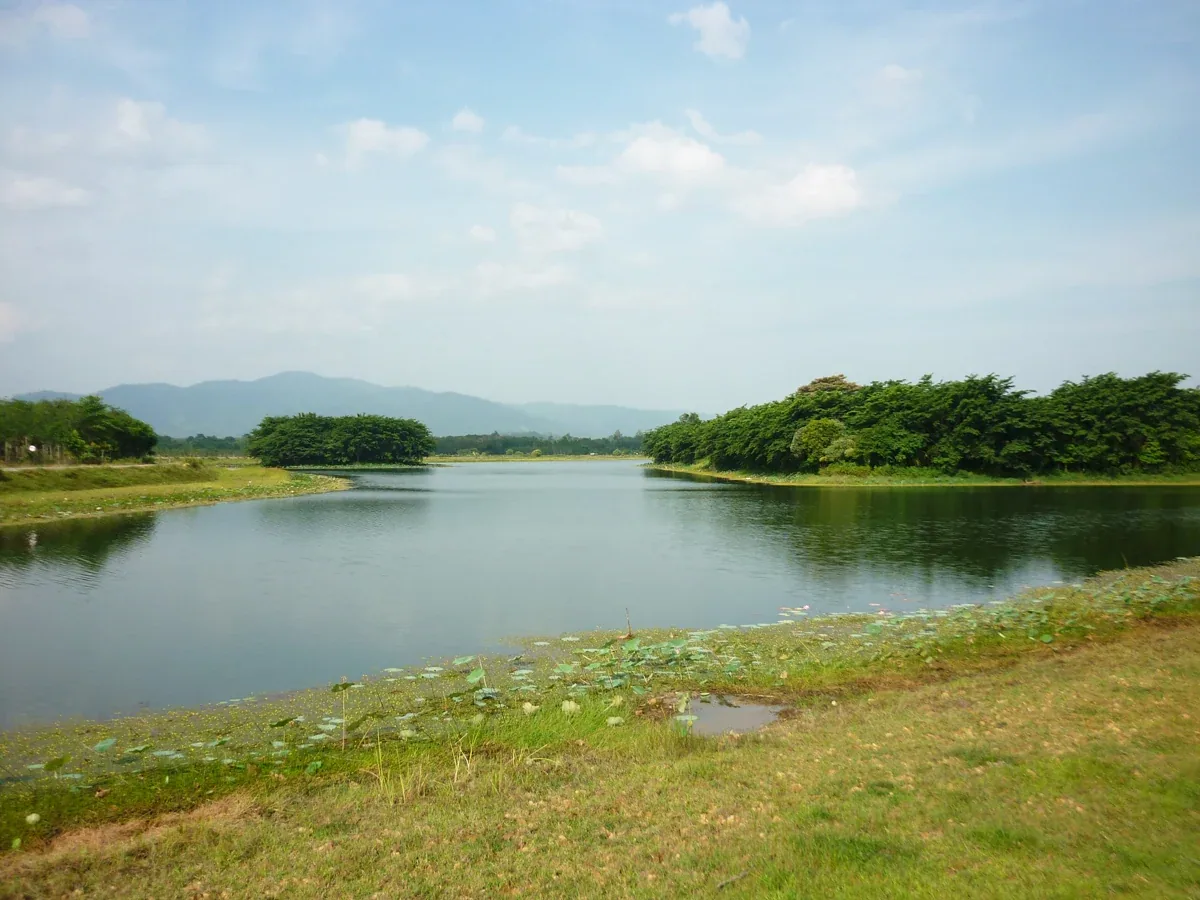
Further east, Bang Lang Dam creates a vast reservoir surrounded by protected rainforest teeming with wildlife. The reservoir stretches for kilometers, its edges dissolving into jungle where wild elephants, tapirs, gibbons, hornbills, and over 200 bird species inhabit one of Thailand's last substantial rainforest areas. Floating restaurants bob on the water, serving fresh fish caught from the reservoir—tilapia, snakehead, catfish grilled with herbs and served with sticky rice and som tam. Boat tours navigate through submerged forest and along shores where, if you're lucky and quiet, you might spot elephants coming to drink at dawn.
The surrounding Hala-Bala Wildlife Sanctuary protects pristine jungle that connects to Malaysia's Belum-Temenggor forest complex, creating one of Southeast Asia's largest contiguous rainforest areas. Serious birdwatchers make pilgrimages here for species found nowhere else, while trekkers seeking authentic jungle experience hire guides for multi-day expeditions. This isn't tourist-friendly infrastructure—it's real wilderness requiring preparation, proper guides, and acceptance that you're entering territory where humans are visitors and nature is uncompromising.
If Betong represents Yala's Chinese heritage, Yala city embodies its Malay-Muslim majority. The Yala Central Mosque (Masjid Klang Yala) dominates the skyline with its broad white facade, central dome and minarets, serving as the religious and architectural heart of the provincial capital. Friday prayers fill the mosque with worshippers, their voices rising in Arabic recitations that echo across surrounding neighborhoods where Islamic shops, halal restaurants, and traditional Malay market stalls create streetscapes distinct from Bangkok or Chiang Mai. Yala city itself is unusual in Thailand for being a planned city — laid out in concentric circles around a central Clock Tower (a Kilometre Zero marker), with radial avenues fanning outward.
The morning market operates like markets across Southeast Asia—vendors calling out prices, motorbikes weaving through crowds, food stalls serving breakfast—but with cultural nuances that mark it as Malay. Women in colorful headscarves dominate the shopping crowd. All meat is halal by default. Vendors speak Pattani Malay as often as Thai, their dialect drawing from Kelantan and Terengganu across the border. Textile stalls display batik fabrics and traditional Malay clothing rather than the ubiquitous tourist T-shirts of northern Thailand. The breakfast options lean toward Malay favorites: roti canai with curry, nasi dagang with fish curry and hard-boiled eggs, kuih (Malay desserts) in rainbow colors.
→ Dress modestly throughout Yala—cover shoulders and knees. Women should bring headscarves for mosque visits.
→ During Ramadan, avoid eating or drinking in public during daylight fasting hours out of respect for those fasting.
→ Learn basic Malay greetings—"Assalamualaikum" (peace be upon you) shows cultural awareness and respect.
→ In Betong, Mandarin or Hokkien phrases are appreciated by older Chinese residents.
→ Ask permission before photographing people, especially women in Islamic dress or at religious sites.
→ Alcohol is generally unavailable in Malay-Muslim areas, though some Chinese establishments in Betong may serve it.
→ Be sensitive discussing politics, religion, or the security situation—these are complex, personal topics.
Despite the Muslim majority, Buddhist temples persist, serving the Thai-Buddhist minority—mostly government workers, military personnel, and long-established Thai families. Wat Khuhaphimuk, a cave temple, draws pilgrims who light incense before Buddha images nestled in natural caverns. The juxtaposition of mosque and temple, Islamic call to prayer and Buddhist chanting, creates a soundscape that captures Yala's religious plurality. It's not always harmonious—the insurgency reflects deeper tensions—but in daily life, these communities coexist, shop at the same markets, ride the same buses, share the same space if not always the same identity.
Yala's cuisine reflects its cultural complexity in delicious ways. In Yala city, Malay food dominates—satay grilled over charcoal, nasi kerabu (herb rice with bright blue coloring from butterfly pea flowers), massaman curry with its Muslim origins, mee goreng (fried noodles with Malay spices), and endless variations of curry, coconut, and rice. Everything is halal. Pork doesn't exist. The flavors lean toward coconut richness, aromatic spices, and the particular heat of southern Thai chilies that make your eyes water.
In Betong, Chinese food culture creates entirely different options. Dim sum breakfast at Chinese coffee shops, where steaming bamboo baskets arrive filled with har gow (shrimp dumplings), siu mai (pork dumplings), char siu bao (barbecue pork buns), and sticky rice wrapped in lotus leaves. Roast duck hangs in restaurant windows, its skin lacquered mahogany. Noodle soups steam in bowls—wonton mee, beef noodle soup, fish ball noodles—each recipe carried from China through generations and adapted to local ingredients.
In Yala City: Nasi kerabu for breakfast (blue rice tinted with butterfly-pea flowers, served with herbs and fish), nasi dagang (steamed rice with tuna or mackerel curry), satay with peanut sauce, massaman curry, roti mataba (stuffed pancakes), kuih (Malay desserts in countless varieties).
In Betong: Morning dim sum at Chinese coffee shops, roast duck rice, wonton noodle soup, eggs boiled in hot springs, Malaysian laksa (spicy coconut noodle soup).
Everywhere: Fresh tropical fruits from markets, Thai southern curry (gaeng tai pla—fermented fish curry that locals love and visitors find challenging), and the unique fusion dishes that exist only here where cultures overlap. Meals cost 30-80 baht, making Yala one of Thailand's most affordable provinces for eating well.
The best experiences come from eating where locals eat. Morning markets for breakfast roti and nasi dagang. Chinese coffee shops in Betong for dim sum and strong kopi. Floating restaurants at Bang Lang Dam for fresh fish grilled tableside. Night markets—locations vary by day—where satay smoke fills the air and vendors grill everything from chicken to squid. Western food is virtually absent, which forces you into local food culture—and that's where Yala's flavors reveal themselves, complex and layered like the province itself. For more insights into Thai food culture across regions, see our guides on Thai cuisine and local eating customs.
"The food in Yala tells the province's story better than any history book—Malay curry meeting Chinese dumplings meeting Thai som tam, three traditions creating something that exists only here, in this complicated corner of the Kingdom."
Getting to Yala requires planning. There's no commercial airport in Yala city—the nearest is Hat Yai, around 130 kilometers north. From Hat Yai, buses run regularly to Yala (2.5 hours, 150 baht), or you can arrange van transfers (1,200-1,500 baht). Trains continue down the southern line from Bangkok Krung Thep Aphiwat (Bang Sue) via Hat Yai to Yala — but note that several foreign governments specifically advise against rail travel south of Hat Yai. Overnight buses from Bangkok take 18-20 hours (1,000-1,500 baht for VIP sleepers), arriving at dawn. Betong has a small airport that opened in March 2022, but scheduled commercial service has been suspended or intermittent since shortly after opening—do not plan on flying in or out of Betong without confirming current operations.
Once in Yala, local transport relies on motorcycle taxis (30-80 baht for most trips) and songthaews running fixed routes through town. The drive from Yala city to Betong takes 2-3 hours through spectacular mountain scenery, with daily buses connecting the two. If you're driving yourself—rental cars are available in Hat Yai—stick to main highways and travel only during daylight hours. The security situation makes rural exploration inadvisable without local guides who understand current conditions.
Accommodation ranges from basic guesthouses (300-600 baht) to comfortable mid-range hotels (600-1,500 baht) to the nicest options like Thai Hotel Betong with pool and spa facilities (1,500-3,000 baht). Standards are more "upscale business hotel" than luxury resort. Most hotels cater to Malaysian weekend tourists and Thai visitors, with halal food, prayer facilities, and staff accustomed to Muslim guests. English proficiency is low—translation apps become essential tools.
The cost of living is extremely low—among Thailand's cheapest. Rent for comfortable one-bedroom apartments runs 5,000-8,000 baht monthly in Yala city, 6,000-10,000 baht in Betong. Meals cost 30-70 baht. Total monthly living costs of 17,000-25,000 baht provide comfortable lifestyle. But there's virtually no recreational expat community—the few foreigners are NGO workers, researchers, teachers on specific programs, or people with family connections. This isn't a digital nomad destination or retirement haven unless you have compelling specific reasons to be here and accept the security context.
Timing matters in Yala. The hot season (February-April) brings scorching temperatures (28-37°C) with minimal rain—good for activities but oppressively hot. The monsoon season (October-January) dumps heavy rain, especially November-December, with flooding possible. But this is also when Betong experiences its "winter"—nighttime temperatures dropping to 15-22°C, cherry blossoms blooming, and the famous Winter Flower Festival (December-January) transforming the town. If you're visiting Betong, December through early February offers the coolest weather and most spectacular blooms.
Yala isn't for everyone. It works for travelers fascinated by cultural complexity, willing to navigate linguistic barriers (Malay, Thai, Chinese dialects with minimal English), comfortable with conservative Muslim cultural norms, and realistic about security considerations. It appeals to those seeking experiences unavailable elsewhere—cherry blossoms in Thailand, communist tunnel history, three-culture fusion. It rewards adventurous spirits who value authenticity over comfort and find complicated places more interesting than simple ones.
It doesn't work for casual tourism or recreational travel. The security context makes it inappropriate for families or anyone uncomfortable with potential risks. The cultural conservatism and lack of English make it challenging for those wanting easy tourism. There's no party scene, no backpacker infrastructure, no Western amenities. This is a province for people with specific interests—cultural anthropology, borderland studies, Islamic culture in Thailand, Chinese diaspora communities, natural history, or simply the desire to understand a corner of Thailand that most travelers never see.
But if you approach Yala with the right expectations—dressing modestly, learning basic phrases in Malay and Chinese, respecting Islamic customs, accepting security realities, and embracing the province's complexity—it offers something increasingly rare: genuine cultural immersion in a place that hasn't been smoothed and simplified for tourist consumption. Temperate flowers bloom in Betong's December gardens. Muslim call to prayer echoes across mountain valleys. Chinese grandmothers speak Mandarin in Thailand's southernmost town. And in these contradictions and complications, Yala reveals itself as perhaps Thailand's most fascinating province precisely because it refuses to be easily understood. For those considering longer stays in unique Thai locations, explore our guides to other provinces and living in Thailand for broader context.
ESSENTIAL INFO
Capital
Mueang Yala
Population
~530,000 (province)
Area
4,521 km²
Language
Pattani Malay, Thai, Chinese (Betong)
BEST FOR
KEY ATTRACTIONS
Active conflict zone. UK FCDO advises against all but essential travel to the whole of Yala. US State Dept: Level 3 "Reconsider Travel".
Emergency Decree has been in force province-wide since July 2005. ~7,000 killed across the Deep South since 2004.
Lower risk (relatively): Betong district and Yala city centre. Still inside the conflict zone.
Insurance: Travelling against advisories typically voids cover. Check your policy before booking.
December - February
Betong's "winter" with cherry blossoms, cool weather (15-22°C at night), Winter Flower Festival
February - April
Driest period, hot but good for outdoor activities
Avoid November
Wettest month with heavy rain and flooding risk