Provinces
🌾Ang Thong
Central Thailand's rice-bowl heartland
Central Thailand's rice-bowl heartland
Drive an hour north of Bangkok on Highway 32 and the rice begins. Not the tidied-up rice paddies of magazine spreads but the working Central Thai rice plain — irrigation canals threading between fields, water buffalo half-submerged in the cool of mid-morning, white-painted village temples rising every few kilometres. Halfway between Ayutthaya and Sing Buri, the gilded crown of a 92-metre seated Buddha catches the sun above the paddy. This is Ang Thong: a small, landlocked province most travellers race past on their way somewhere else, and one of the most quietly photogenic corners of Central Thailand.
Ang Thong sits squarely on the Chao Phraya river plain, bordered by Suphan Buri to the west, Sing Buri to the north, Lopburi to the east and Ayutthaya to the south. The province has no coastline; what it has instead is the Chao Phraya and the Noi rivers, a 968-square-kilometre patchwork of paddy and orchard, and roughly 268,000 residents who quietly make about a fifth of Thailand's drums and one of its better-known basketry traditions. (Travel writers sometimes confuse it with Mu Ko Ang Thong National Marine Park, which is a 42-island archipelago in Surat Thani Province, off Ko Samui — a different place, hundreds of kilometres south.)
What makes the province worth a weekend, or a longer stay, is what's still working. The temples are not ruins — they hold full congregations on Sunday mornings. The craft villages aren't museums — drum-makers in Pa Mok are taking orders for upcountry temple festivals; basket-weavers in Bang Chao Cha are filling commissions for the same Bangkok galleries you might walk past in Thonglor. The Great Buddha of Thailand at Wat Muang dominates the skyline of Wiset Chai Chan district from kilometres away, and on weekdays you can have its enormous golden lap nearly to yourself. From a Bangkok base, it's an easy day trip via the Mo Chit Northern Bus Terminal (under two hours, around 100-150 baht); for visitors already in Ayutthaya, it's a half-hour drive north.
"Ang Thong is the province most travellers race past on their way somewhere else — and one of the most quietly photogenic corners of Central Thailand."
Wat Muang is impossible to miss and not easy to forget. Phra Buddha Maha Nawamin — Thailand's tallest seated Buddha — rises 92 metres including its pedestal (the seated figure itself is 84 metres), constructed in stages between the late 1980s and 2008, painted a saturated gold that catches every angle of light across the surrounding rice paddies. Climb the small staircase inside the pedestal to look out through window-level openings; the view is more of the temple grounds than the countryside, but the scale of the statue from underneath is the point. The same compound holds the Naraka (Hell) Garden, a startling open-air gallery of life-size sculptures depicting Buddhist cosmology and the punishments meted out to those who break its precepts. Children love it; squeamish adults do not. Free entry, donations welcome.
A short drive south brings you to Wat Pa Mok Worawihan, where a 22-metre reclining Buddha pre-dating Ayutthaya was famously relocated in its entirety in the early 18th century to escape the eroding Chao Phraya bank — an operation that became a minor royal legend. Further into Wiset Chai Chan district, Wat Khian preserves an unusually intact set of late-Ayutthaya murals: Jataka scenes painted on the ubosot walls, the colours faded but the figures still doing their everyday things. To the north, Wat Chaiyo Worawihan holds Phra Maha Phuttha Phim, a much-revered nineteenth-century seated Buddha rebuilt after King Mongkut had the original site restored. None of these temples charges entry; none has the parking lot or tour-bus throng of Ayutthaya's headline sites; all reward modest dress and a willingness to take your shoes off.
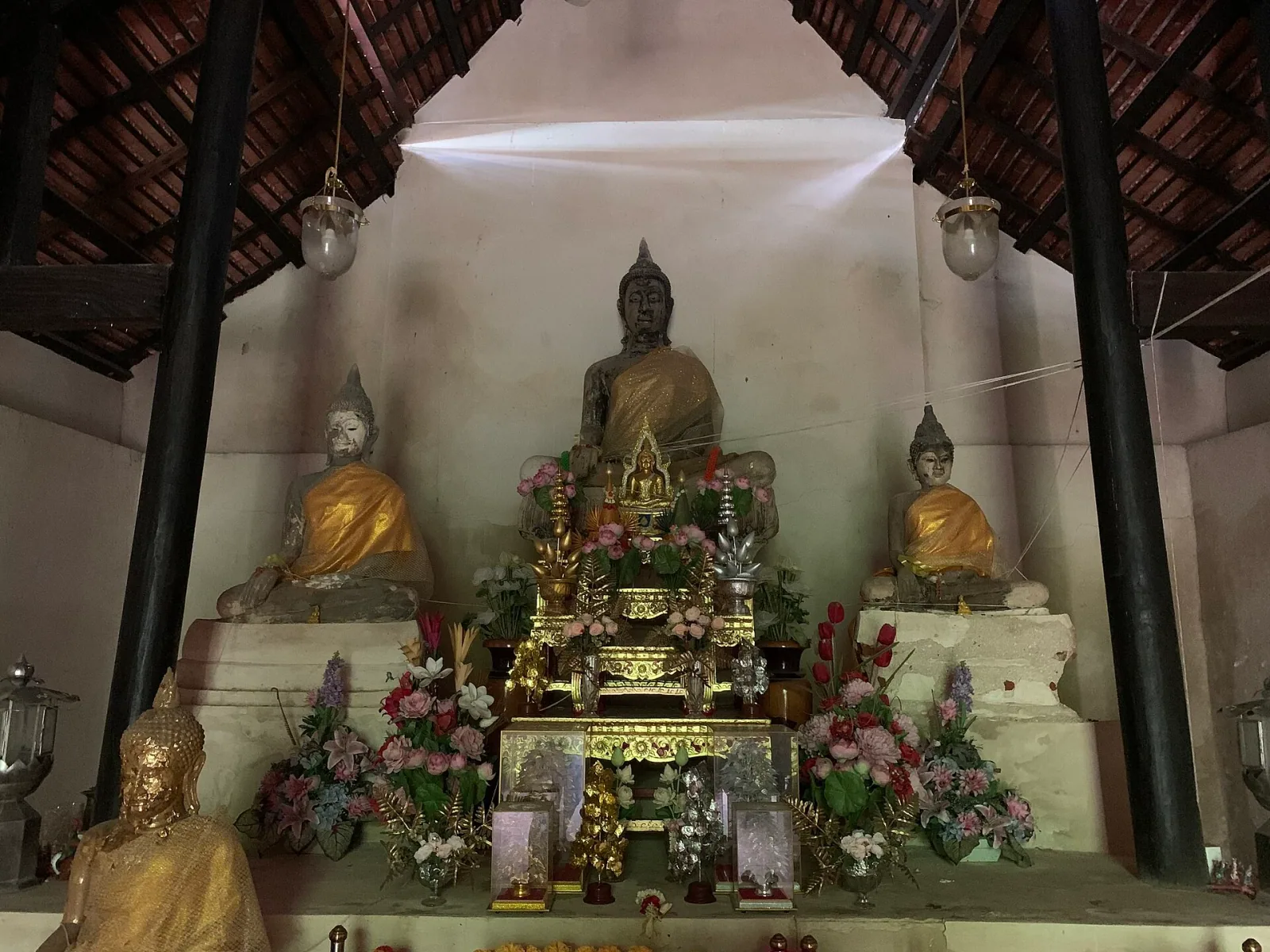
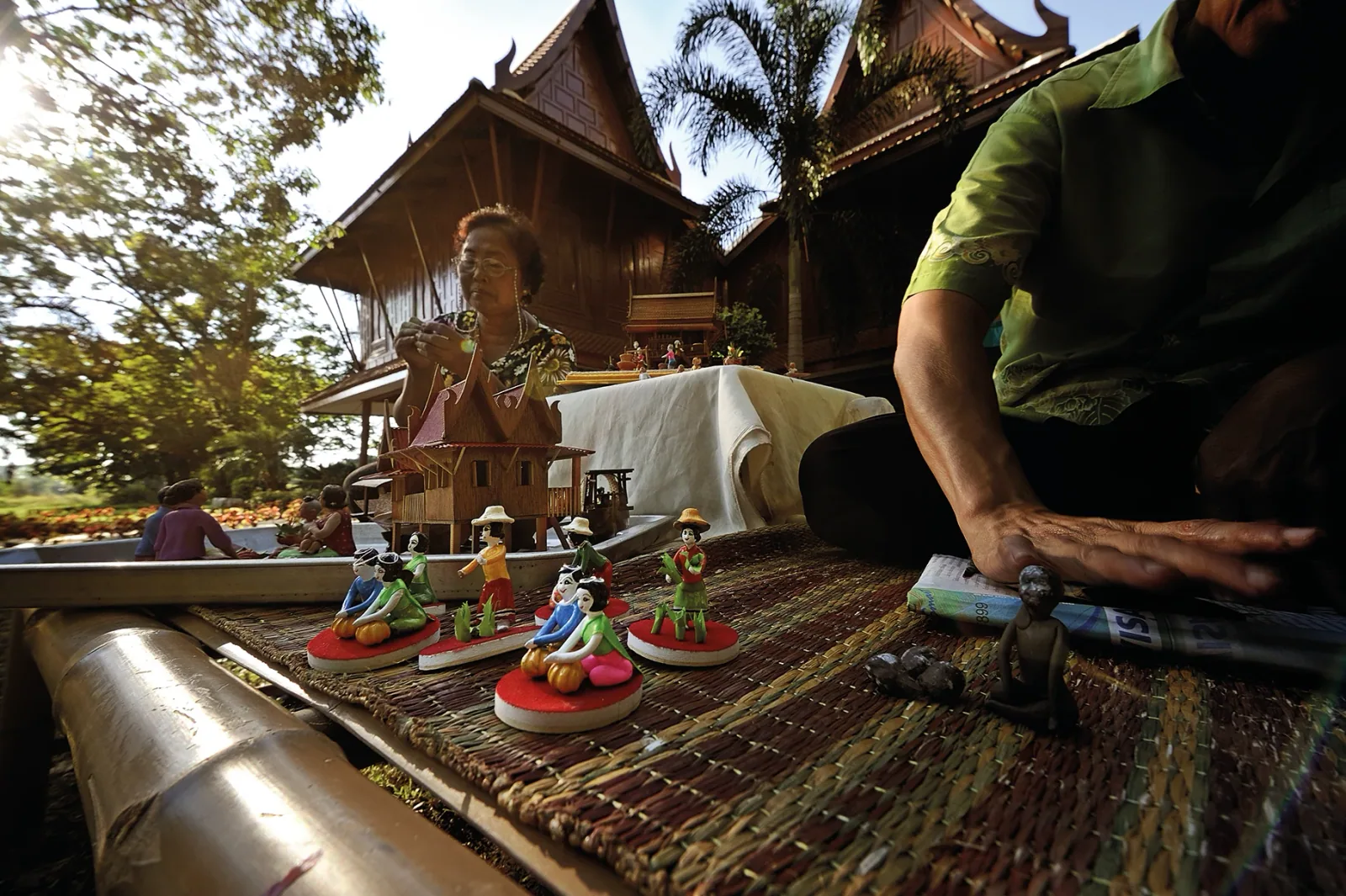
Ang Thong's craft villages are the quiet reason Bangkok residents come up for a Saturday. Ban Bang Pho Long, in Pa Mok district, has been turning out klong yao (long drums), klong that phon, and other Thai percussion instruments for more than a century. Walk into any of the family workshops and you'll see hollowed sections of teak or mango wood waiting for hide; outside, finished drums stacked taller than the workshop dog, ordered by upcountry temples for the next festival cycle. Small souvenir drums sell from a few hundred baht; full-size temple drums many thousands. The same district holds Ban Bang Sadet, where a 1970s royal initiative turned a small village into the country's best-known producer of the costumed Thai dolls you see in Bangkok craft shops. You can watch the painstaking sequence from wire armature to hand-sewn silk to painted face, then buy direct.
Ban Bangchaocha is Thailand's most famous fine-bamboo basketry village. The cooperative produces lacquered baskets, bowls, handbags, and lampshades that turn up in Thonglor design shops at multiples of the village price. There's a small learning centre with a demonstration loom, and the older artisans will sometimes let you sit in long enough to confirm you don't have the patience for it. The flat terrain between these villages and the temple circuit makes a perfect cycling day; bicycles rent for 50-100 baht daily from guesthouses in Mueang Ang Thong, and you'll find more curious locals waving at the foreign cyclist than other foreign cyclists.
The provincial market in Mueang Ang Thong is small, busy, and almost entirely free of tourist mark-up. Pre-dawn arrivals get the best of the river fish coming off the Chao Phraya; by mid-morning the prepared-food stalls take over with curries, sticky rice, and Suphan-style sweets. The evening market is even quieter — a handful of stalls, a few outdoor tables, neighbours catching up. There is no English signage and very little English spoken. For broader Thai cultural context, see our guide to Thai festivals and holidays.
"The temples are not ruins. The craft villages aren't museums. The drum-makers are taking orders for next month's upcountry festival, and the Bangchaocha basket you buy in the village will turn up in a Bangkok gallery at three times the price."
Ang Thong's greatest advantage is accessibility. The province sits roughly 105 kilometres north of Bangkok, a 90-minute to two-hour drive via Highway 32. Public buses depart regularly from Bangkok's Mo Chit Northern Bus Terminal (100-150 baht). Trains on the Northern line stop at Ang Thong's small station, though most travellers find the bus more frequent. From Ayutthaya the drive is around 40 minutes; from Suphan Buri or Sing Buri, less. Within the province you'll want your own wheels — a rented motorbike, a hired songthaew for the day, or a bicycle if you're sticking close to town.
Accommodation runs from very basic guesthouses (400-600 baht nightly) to a handful of small hotels (700-1,500 baht). Long-term rentals run 4,500-7,500 baht monthly for studios, 5,500-9,000 baht for one-bedrooms — comfortably below Bangkok rates. Town-centre locations put you near the markets and the bus terminal; riverside addresses are quieter and put you near the cycling routes. Utilities typically run 600-900 baht monthly; town-centre internet is fine for remote work but won't match Bangkok or Chiang Mai fibre. For broader cost context, see our Thailand cost of living guide.
Accommodation: Studio apartment in town centre: 5,000-6,000 THB
Utilities: Electric, water, internet: 800-1,200 THB
Food: Local markets and occasional restaurants: 5,000-7,000 THB
Transportation: Motorbike or bicycle plus fuel: 1,500-2,500 THB
Bangkok / Ayutthaya day trips: 1,500-2,500 THB
Miscellaneous: Healthcare, entertainment: 1,500-2,500 THB
Comfortable provincial lifestyle: 16,000-22,000 THB/month
The climate is straightforward Central Thai plain: cool and pleasant November through February (18-30°C), brutally hot March through May (often 38-40°C), and humid with afternoon thunderstorms June through October. The Chao Phraya occasionally rises high enough to flood low-lying districts during peak monsoon, though the dykes around the main attractions usually hold. The best months for cycling and temple-hopping are December and January; the rest of the year is more about early starts and shaded breaks.
There is almost no expat community here. English is rare outside hotels; learning a few Thai phrases pays back quickly. Healthcare is adequate for routine matters at Ang Thong Hospital and a couple of private clinics; for anything specialised, Ayutthaya or Bangkok are the next steps — both reachable in under two hours.
Ang Thong works best for visitors who want a single quiet day or two amid working Central Thai life, and as a long-term base for those who like Ayutthaya's UNESCO temples (40 minutes south), Suphan Buri's countryside (an hour west), and Bangkok's airport access without Bangkok's rent. The Great Buddha will still be there, the drum-makers will still be working, and the rice plain will still stretch to the horizon — quietly, on its own time.
Population
~268,000 (province)
Area
968 km² — landlocked Central plain
Best Time
November-February (cool season)
Distance from Bangkok
~105 km (1.5-2 hours by car)
Signature Landmark
Wat Muang's 92-metre Great Buddha
Best For
Day-trippers from Bangkok or Ayutthaya, temple visitors, craft enthusiasts, budget-minded remote workers wanting easy Bangkok access without Bangkok rent
From Bangkok: 1.5-2 hour drive via Highway 32, or bus from Mo Chit Northern Terminal (100-150 THB)
From Ayutthaya: ~40 minute drive north on Highway 309 / 32
Train: Northern line trains stop at Ang Thong station; less frequent than buses