Provinces
🐊Phichit Province
The Crocodile City on the Nan River
The Crocodile City on the Nan River
The sign appears suddenly on the highway: "Welcome to Phichit—Thailand's Crocodile City." You might think it's a tourism slogan, a bit of provincial branding to differentiate one small Thai city from another. Then you start noticing the farms. Not rice paddies or rubber plantations, but concrete ponds filled with hundreds—sometimes thousands—of crocodiles basking in the sun, their prehistoric forms motionless until feeding time transforms them into thrashing, powerful predators. Over 30 such farms operate throughout Phichit Province, housing an estimated 100,000 crocodiles. This is not a zoo or tourist attraction. This is an industry, a livelihood, and the defining characteristic of one of Thailand's most unusual provinces.
Phichit Province sits in lower-northern Thailand, around 340 kilometers north of Bangkok, where the Nan River curves through agricultural valleys. The province spans roughly 4,531 square kilometers with a population of about 517,000, most involved in farming—rice, vegetables, and, of course, crocodiles. Phichit town, the provincial capital of around 23,000, maintains the character of authentic provincial Thailand: wooden shophouses along the river, morning markets where no English is spoken, temples where monks collect alms from kneeling locals who've performed this ritual for decades.
What brings the small but growing number of expats to Phichit isn't the crocodiles, really—though they're certainly a conversation starter. It's the combination of rock-bottom cost of living, genuine Thai culture untouched by tourism, and the quiet satisfaction of living somewhere utterly unlike anywhere else. If you've grown tired of Chiang Mai's digital nomad scene, Bangkok's chaos, or island tourism's commercialization, Phichit offers an alternative: authentic, affordable, and wonderfully strange.
"Phichit offers an alternative to Thailand's tourist trail: authentic, affordable, and wonderfully strange—a province where 100,000 crocodiles are just part of daily life."
The crocodile farms range from small family operations with a few dozen animals to industrial-scale facilities housing thousands. Most focus on breeding crocodiles for leather—handbags, wallets, belts destined for international fashion markets. Some farms welcome visitors, offering tours where you'll watch feeding sessions (dramatic and slightly terrifying), see hatchlings in nursery ponds, and learn about the breeding cycles that have made Phichit the center of Thailand's crocodile leather industry.
Walking through one of the larger farms, you're struck by the scale. Hundreds of crocodiles packed into concrete pools, their eyes tracking your movement with that ancient reptilian patience. Feeding time involves buckets of fish parts and chicken thrown to trigger feeding frenzies that would make any nature documentary producer jealous. The farm owners approach this with the same matter-of-fact professionalism you'd see at a dairy farm—these are livestock, dangerous livestock requiring careful handling, but livestock nonetheless.
The industry's importance to Phichit's identity cannot be overstated. Local shops sell crocodile leather products at wholesale prices, and the Siamese crocodile is the province's official aquatic animal. What started decades ago as a niche agricultural diversification has evolved into Phichit's calling card—quirky, profitable, and impossible to ignore.
Beyond the crocodiles, Phichit's real character emerges along the Nan River. This major tributary flows through the province, creating the valley that supports agriculture and shapes local life. Early morning, you'll see fishermen casting nets from long-tail boats. By midday, the riverfront comes alive with vendors selling grilled fish and som tam. Evening brings families to the riverside parks, teenagers practicing dance routines, elderly couples taking slow walks while the sun sets over water that turns gold and then purple.
The old town preserves wooden shophouses painted in faded pastels—blue, yellow, pink—their ground floors now functioning as small shops, restaurants, or simply family homes. Unlike northern Thailand's carefully restored old towns designed for tourists, Phichit's heritage buildings serve their original purposes. You might find a shop selling motorcycle parts next to one selling traditional sweets, both operating from century-old structures maintained through use rather than restoration.
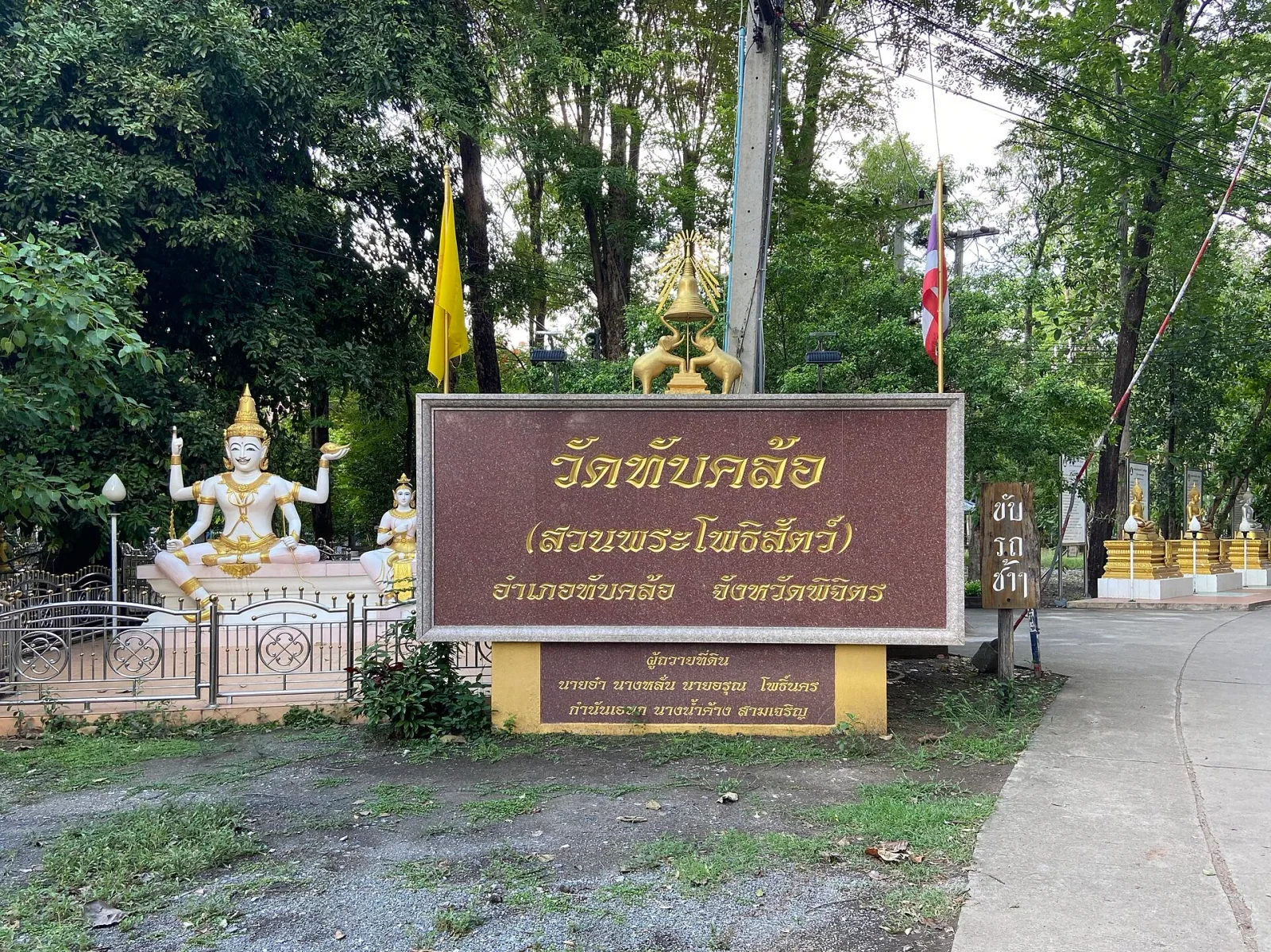
Wat Tha Luang, the province's most revered temple, sits on the western bank of the Nan River in the town centre. Its principal image is Luang Pho Phet, a seated Chiang Saen-style bronze Buddha in the subduing-Mara posture, said to have been brought down the river from the north and the focus of an annual September procession. Monks welcome visitors with the understanding that you're here out of genuine interest rather than tour-group obligation. The morning alms round happens before dawn—locals kneeling with prepared food, monks walking their prescribed route, the ritual proceeding with quiet dignity. This is Buddhism as daily practice rather than tourist spectacle. For more on Buddhist culture in daily Thai life, explore our cultural guides.
From Bangkok: Phichit station sits on the Northern Line. Around six daily trains run direct from Krung Thep Aphiwat (Bang Sue Grand)—Bangkok's main long-distance rail hub since 2023—taking roughly 3h 40m on the fastest services to over 5 hours on the slow ones, with fares from about 90 THB (third class) to around 800 THB (sleeper berth). Minivans and buses also depart Mo Chit (Northern Bus Terminal) regularly, taking around 5-6 hours for 200-350 THB.
From northern provinces: Chiang Mai is 6-7 hours via mountain routes. Sukhothai is around 1h 45m northwest—easy day trip to the UNESCO historical park.
Local transport: The town centre is walkable, but rent a scooter (1,500-2,500 THB/month) to reach crocodile farms, Mueang Kao, and riverside areas. Songthaews run the main routes for 15-40 THB.
The crocodile farms aren't an arbitrary local industry. Phichit's identification with crocodiles reaches back centuries, to the folk epic of Krai Thong—a young commoner who descended into a riverbed cave to slay the giant magical crocodile Chalawan and rescue the daughters Chalawan had abducted. The story is set right here on the Nan River and is taught to Thai schoolchildren as a foundational tale. You'll find it referenced everywhere in town, but most visibly at Bueng Si Fai, the central city lake fringed by parkland and crowned with a towering concrete statue of Chalawan—mouth open, fangs bared, surfacing from the water as if straight out of the story. Local families come at dusk to walk the perimeter, hire paddle boats, and eat at the lakeside stalls.
Bueng Si Fai is also the launching point for understanding Phichit's older self. A short ride south brings you to the ruins of Mueang Kao (Old Phichit), the original walled city founded around the 11th century and abandoned after the late-Ayutthaya wars. The remnant moat, laterite city walls, and Sukhothai-era brick chedis of Wat Mahathat and Wat Nakhon Chum sit in tranquil overgrown grounds—the kind of historical site you'll often have entirely to yourself. Across the Nan in Pho Prathap Chang district, Wat Pho Prathap Chang marks the birthplace of King Suea (Phra Chao Suea, "the Tiger King"), one of late-Ayutthaya's more colourful monarchs, born in Phichit in 1661.
None of this is signposted in English. Visiting feels like personal discovery rather than ticking off attractions—exactly the appeal for travellers tired of organised heritage tourism.
Here's what drew me to spend three months in Phichit: you can live extraordinarily well on less money than almost anywhere else in Thailand. My one-bedroom apartment three blocks from the river, with air conditioning, hot water, WiFi, and a small balcony, cost 6,000 baht per month. That's $170. Utilities added another 1,000 baht. Internet was 350 baht for fiber that, while not blazing fast, handled video calls and Netflix without issue.
Food costs border on absurd. Street food meals—pad thai, khao pad, noodle soup—run 30-50 baht. Sit-down restaurant meals rarely exceed 80 baht. The morning market offers produce at prices that seem mistaken: mangoes for 20 baht per kilo, vegetables so cheap I stopped tracking, fresh river fish for 60-100 baht that would feed two people. I ate well—very well—for 5,000-6,000 baht monthly, and I wasn't trying to minimize costs.
My total monthly budget, living comfortably with occasional splurges, ran about 15,000-18,000 baht ($425-510). This included everything: rent, food, scooter rental, entertainment, unexpected purchases. For remote workers earning Western salaries, these numbers are almost comical. For retirees on fixed incomes, they're transformative. You're not just getting by—you're living well, saving money, and discovering that financial stress can simply evaporate when your monthly expenses equal what you used to spend on a nice weekend out.
→ Rent (1-bedroom near river): 6,000-8,000 THB
→ Utilities (electricity, water, internet): 1,200-1,500 THB
→ Food (eating local, cooking some): 5,000-7,000 THB
→ Scooter rental: 1,500-2,000 THB/month
→ Activities and exploration: 1,000-2,000 THB
→ Miscellaneous: 1,000-2,000 THB
Total: 15,700-22,500 THB ($445-640) for comfortable living
Let me be direct about limitations. The expat community numbers perhaps 30-100 people, mostly remote workers and a few retirees. There's no expat bar, no Sunday morning coffee meetup, no organized social infrastructure. You'll build friendships, but you'll do it the old-fashioned way—through repeated encounters, genuine interest, and effort. If you need a ready-made community, this isn't it.
English is rare outside a few guesthouses. Restaurants don't have English menus. Government offices definitely don't have English-speaking staff. You'll need Google Translate, pointing, and ideally some basic Thai phrases. Medical care is adequate for routine issues—the provincial hospital handles basics—but serious problems require the train or a five-to-six-hour drive to Bangkok. Travel insurance isn't optional; it's essential.
Entertainment and dining options are limited. There are no international restaurants serving decent pasta or Mexican food. Coffee shops are emerging slowly—you'll find a few decent cafes—but don't expect specialty roasters or third-wave coffee culture. Nightlife consists of a few Thai-style karaoke bars and beer gardens. If you need variety, stimulation, or regular access to Western food and entertainment, Phichit will feel restrictive.
"Phichit trades convenience for authenticity and affordability. You'll need self-reliance, basic Thai skills, and comfort with being one of maybe 50 foreigners in a town of around 23,000."
The expats who genuinely love Phichit share certain characteristics. They're comfortable with solitude and self-reliance. They find joy in small discoveries—a particularly good som tam vendor, a sunset view from the river bridge, conversations with the pottery artisan who's started recognizing them. They're here for the experience of living somewhere completely non-touristy rather than for amenities or social life.
Remote workers comprise much of the small expat population. The cost of living means you can work part-time, save aggressively, or simply stress less about money. Internet is adequate if not exceptional—I managed video calls and collaborative work without major issues, though I kept a mobile hotspot as backup during the occasional fiber outage. The lack of distractions actually helps productivity; there's no temptation to "just quickly" meet friends for lunch when friends are 30 people scattered across town.
Retirees on fixed incomes find Phichit particularly appealing. Your social security or pension goes incredibly far. Healthcare limitations are real but manageable—routine care locally, planned trips to Bangkok for anything serious, which you can afford because your monthly budget is so low. Several retirees I met had tried more popular expat destinations and found them too expensive, too touristy, or too crowded. Phichit offered something different: genuine Thai life at a pace and cost that made long-term living sustainable.
And there are the adventurers—people drawn specifically to places that haven't been discovered yet. They appreciate that Phichit has no guidebook chapter, no "Top 10 Things to Do" listicle, no Instagram-famous viewpoint. They like explaining to friends back home that they live in the crocodile province, knowing this requires a story rather than a stereotype. They understand that the best experiences come from engagement rather than consumption.
Phichit follows central Thailand's climate patterns. November through February brings comfortable weather—16-28°C, clear skies, and the best time for exploring. December and January can actually feel cold in early mornings; I wore a light jacket cycling to the morning market. This is when you should visit if you're considering a longer stay, when the province shows its best face.
March through May turns brutally hot. 36-39°C with high humidity makes outdoor activities exhausting. Agricultural burning sometimes impacts air quality. Many expats schedule trips elsewhere during April and May—the hottest, least pleasant months. The rainy season (June-October) brings afternoon thunderstorms, lush landscapes, and comfortable temperatures. The rain rarely lasts all day; you adapt by doing outdoor activities in the morning and accepting that afternoons might involve sudden downpours.
Phichit won't suit everyone, and that's precisely the point. This is Thailand for people who don't want the Thailand everyone else has. No beach, no mountains, no UNESCO listings, no ready-made expat community or English-friendly services. Just a working Thai town along a river where people farm rice and crocodiles, where Sukhothai-era ruins sit unvisited a few kilometres out, and where life proceeds largely independent of tourism.
What it offers instead is authenticity, affordability, and the satisfaction of living somewhere genuinely different. You'll spend less money than you thought possible. You'll learn more Thai because you have to. You'll make fewer friends but deeper ones. You'll discover that entertainment doesn't require restaurants and bars—that a conversation with your pottery teacher, a sunset bike ride along the river, or an afternoon watching crocodile feeding can be enough.
If you need to ask whether Phichit is right for you, it probably isn't. But if you're tired of performing tourism in places designed for tourists, if you want to live in Thailand rather than visit it repeatedly, if you're comfortable with challenge and uncertainty and the occasional moment of wondering what exactly you've gotten yourself into—then Phichit might be exactly what you didn't know you were looking for. At the very least, you'll have a hell of a story about the time you lived in Thailand's crocodile capital. For more guidance on living in authentic Thai communities, explore our guides to different regions of Thailand.
Provincial Capital
Phichit City
Population
~517,000 (province)
Distance from Bangkok
~340 km north
Unique Feature
30+ Crocodile Farms
BEST FOR
NOT IDEAL FOR
Emergency Numbers
Sukhothai Historical Park
1.5 hours · UNESCO World Heritage
Nakhon Sawan
1 hour · River confluence, larger city
Bangkok
4 hours · Visa runs, shopping