Provinces
🚣RATCHABURI
Floating markets, ancient pottery, and mountain retreats west of Bangkok
Floating markets, ancient pottery, and mountain retreats west of Bangkok
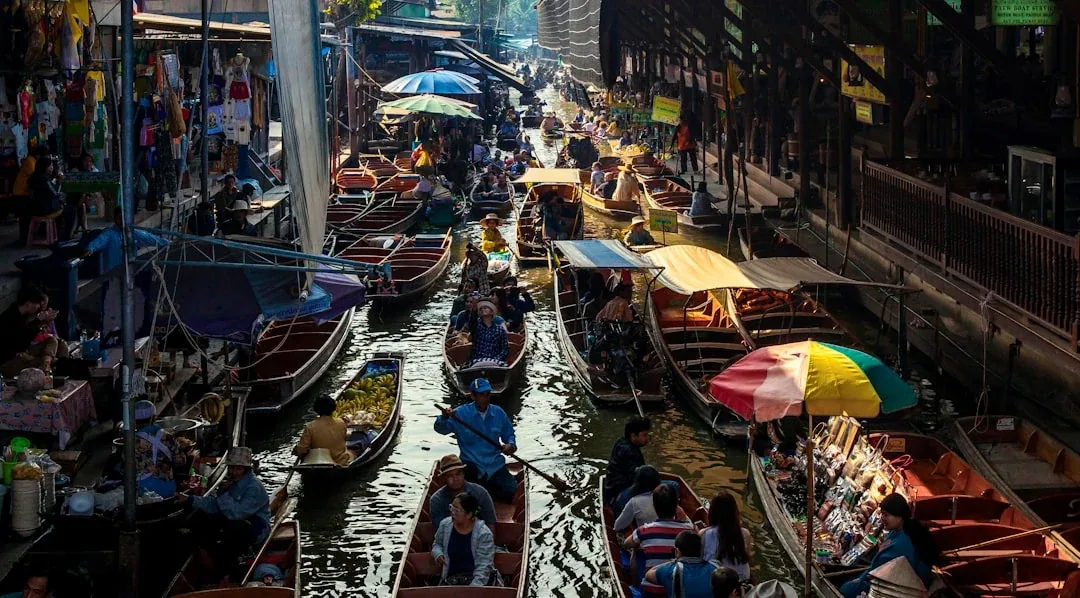
The alarm goes off at 5am. Too early for most tourists, which is precisely the point. By six, you're standing on a narrow wooden bridge watching the Damnoen Saduak canals come alive with commerce that has played out the same way for over a century. Vendors in conical hats paddle wooden boats laden with tropical fruit, fresh vegetables, and steaming bowls of noodles. They call out prices in rapid Thai, negotiating with housewives leaning from their canal-side homes and a handful of bleary-eyed travelers smart enough to arrive before the tour buses. This is Ratchaburi's face to the world—traditional water commerce frozen in time—but it's just one thread in a province that continues to produce most of Thailand's coconut sugar, maintain centuries-old pottery traditions, and hide mountain retreats where Bangkok residents escape for cool air and strawberry farms.
Ratchaburi Province occupies 5,196 square kilometers starting just 100 kilometers west of Bangkok, stretching through fertile Mae Klong River valleys, across rice paddies dotted with sugar palms, and up into mountains brushing the Myanmar border. Its 850,000 residents live in a landscape defined by agriculture and traditional industry—this is where your palm sugar comes from, where artisans still throw clay pots in wood-fired kilns, where Karen hilltribe communities maintain their weaving traditions in western mountain villages.
The floating market gets the headlines, and truthfully, Damnoen Saduak is worth the early wake-up call despite the crowds. But Ratchaburi's real appeal lies in how much of it operates on Thai terms rather than tourist expectations. Pottery villages in Ban Khu Bua where you can watch dragon jars take shape exactly as they have for generations. Suan Phueng's misty mountain valleys dotted with European-themed cafes, strawberry farms, and the Bo Khlueng hot springs bubbling up from mountains near the Myanmar border. Working railway-junction towns like Ban Pong where Southern Line trains thread the heart of the local fresh market. (For the famous awning-folding spectacle of trains splitting market stalls in two, that's Mae Klong Railway Market in neighbouring Samut Songkhram, not Ratchaburi.) This is a province you can traverse in a day but would take years to fully understand.
"This is Ratchaburi's face to the world—traditional water commerce frozen in time—but it's just one thread in a province that continues to produce most of Thailand's coconut sugar, maintain centuries-old pottery traditions, and hide mountain retreats."
Let's address the elephant—or rather, the tourist-filled longboat—in the room. Damnoen Saduak Floating Market, established as a tourism destination in the early 1980s along a canal network dug under King Rama IV in the 1860s, is unabashedly touristy. By 9am, tour groups from Bangkok clog the narrow canals, vendors quote prices in multiple languages, and the whole operation feels choreographed for cameras. Yet arrive before 7am and you'll catch something genuine: the market waking up, vendors setting up boats, local commerce happening before the performance begins.
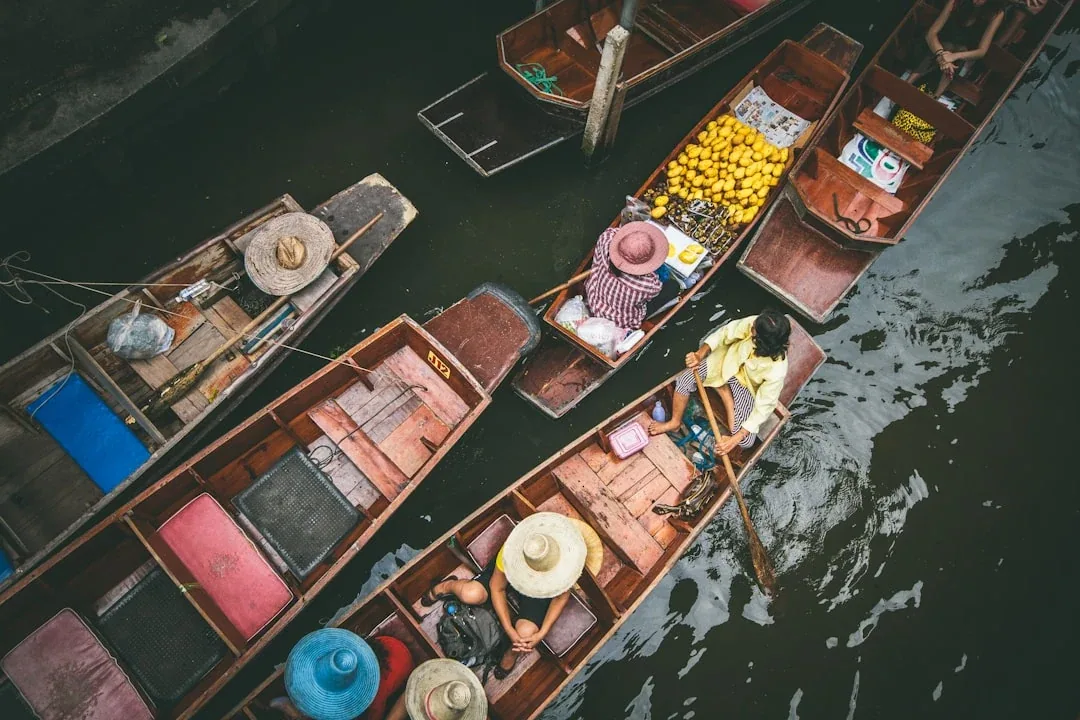
The canal system itself remains authentically Thai—narrow waterways lined with wooden houses on stilts, vendors paddling boats loaded with pyramids of mangosteens and rambutans, makeshift kitchens aboard vessels serving khanom jeen (rice noodles) and spicy curries for breakfast. Women in traditional dress pole their boats with practiced ease, pulling alongside to sell directly to houses and fellow vendors. Purchase som tam from a boat kitchen, watch it prepared fresh while floating, eat it standing on a footbridge as the sun burns through morning mist. That's worth any amount of tourist chaos that comes later.
If Damnoen Saduak feels too staged, Amphawa Floating Market—45 kilometers east near Samut Songkhram—offers a weekend alternative with more local flavor and fewer tour groups. Or simply acknowledge that Damnoen Saduak's commercialization paid for its preservation. Without tourist revenue, these canals would likely be filled in and paved over, the boats replaced by pickup trucks, the vendors working factory jobs in Bangkok. Sometimes tourism saves what it also changes.
Drive through rural Ratchaburi and you'll pass fields dotted with massive clay jars drying in the sun, workshops with open fronts revealing potters at their wheels, brick kilns billowing smoke. This province is Thailand's dragon-jar pottery heartland, particularly around Ban Khu Bua, where families have thrown clay for so many generations that nobody remembers when it started.
The signature product is ong mangkorn—dragon jars. Massive terracotta water storage vessels, some standing waist-high, decorated with relief dragons and traditional patterns. Before indoor plumbing and refrigeration, every Thai household needed these jars for storing rainwater and keeping it cool. While plastic tanks have largely replaced them functionally, the jars endure as decorative pieces, planters, and status symbols. Watching them made is mesmerizing: clay coiled and shaped by hand on foot-powered wheels, details carved while the clay is leather-hard, then fired in massive wood-fed kilns that run for days, reaching temperatures that turn local clay its characteristic red-brown.
Many workshops welcome visitors—you can try the wheel yourself, though producing anything beyond a lopsided bowl requires years of practice. The real value is seeing traditional craft alive and economically viable, passed from grandparents to grandchildren not as historical reenactment but as living work. Prices are wholesale-level: small pots for 50-100 baht, medium jars 200-500 baht, massive dragon jars 1,000-3,000 baht depending on size and detail. Just figure out the shipping logistics before you fall in love with a 50-kilogram masterpiece.
→ Damnoen Saduak Floating Market—arrive before 7am to beat tour group crowds
→ Ban Pong Railway Market where vendors fold up stalls seconds before trains pass through
→ Khao Ngu Stone Park's limestone mountains with caves, temples, and panoramic views
→ Pottery villages crafting traditional dragon jars using centuries-old techniques
→ Suan Phueng hill station with cool mountain air, European-themed resorts, and strawberry farms
→ Bo Khlueng hot springs in Suan Phueng offering mineral-rich thermal pools in mountain forest
→ Karen hilltribe villages maintaining traditional weaving near the Myanmar border
Look up while driving through Ratchaburi's countryside and you'll see them: tall sugar palms rising above rice paddies, their fronds fan-shaped at the top like botanical exclamation points. Twice daily—early morning and late afternoon—farmers scale these palms using nothing but a rope loop for foothold, climbing 20 meters to tap the sweet sap that collects in clay pots hung below the flowering stems.
The collected sap is boiled down in massive woks over wood fires until it thickens into coconut palm sugar—nam tan puek. The province produces most of Thailand's authentic palm sugar, the real stuff with complex caramel notes and mineral undertones that mass-produced alternatives can't match. Processing workshops in Damnoen Saduak and Bang Phae districts welcome visitors to watch the transformation: clear sap bubbling and darkening over hours of stirring, poured into coconut shells or molded into blocks, cooled into golden-brown rounds stamped with the producer's mark. Try a piece fresh—it tastes like toffee mixed with earth, sweet but grounded, the flavor that defines Thai desserts and savory dishes alike.
As you drive west from Ratchaburi town, the landscape transforms. Rice paddies give way to foothills, foothills rise into mountains, and the temperature drops degree by blessed degree. Suan Phueng district sits in these western highlands, closer to Myanmar than Bangkok, a Thai hill station that somehow decided to cosplay as European countryside.
The absurdity is part of the charm: pseudo-Swiss chalets, fake windmills, strawberry-picking farms, cafes serving overpriced lattes alongside mountain views that would cost ten times more in Switzerland. Bangkok residents flee here on weekends for the cool air (genuinely pleasant year-round due to elevation) and Instagram opportunities in front of fake European landmarks. But beneath the themed-resort surface lies real appeal: winding mountain roads through valleys where morning mist clings until mid-morning, the Bo Khlueng hot springs bubbling up in Suan Phueng's forested mountains, Karen villages where traditional weaving and hilltribe culture continue far from tourist cameras.
The Bo Khlueng hot springs in Suan Phueng district offer the region's most authentic experience. Natural thermal pools (around 38-45°C) set among mountain forest, several resorts providing private soaking tubs and day-use facilities, therapeutic treatments leveraging the mineral-rich water. It's popular with Bangkok weekenders seeking nature and relaxation, so midweek visits offer quieter contemplation. The springs themselves have been used for centuries—local Thais knew about therapeutic hot water long before anyone built a resort around it.
Floating Market timing: Arrive at Damnoen Saduak before 7am for authentic market operations. By 9am it's a tour group circus. Combine with Amphawa (weekends only) or the Maeklong Railway Market in nearby Samut Songkhram for a full day of traditional markets.
Pottery villages: Ban Khu Bua welcomes visitors during business hours (8am-5pm). Ask permission before photographing artisans at work. Expect wholesale prices—small items make excellent gifts if you can manage the weight.
Mountain areas: Book Suan Phueng and Chom Bueng accommodation in advance for weekends—Bangkok residents book up the better resorts. Midweek visits offer better rates and quieter experiences.
Transportation: You need private transport (rental car or motorcycle) for pottery villages, mountain areas, and hot springs. GPS works reliably. Grab operates in town but coverage is limited in rural areas.
Ratchaburi attracts a small but growing expat presence—primarily retirees, English teachers, and those married to Thai nationals. The appeal is straightforward: authentic Thai life with extremely low costs and easy access to Bangkok's services when needed. One-bedroom apartments in town center run 4,000-8,000 baht monthly, two-bedroom suburban houses 6,000-12,000 baht. A comfortable monthly budget including rent, food, utilities, and transportation: 20,000-37,500 baht depending on lifestyle.
The trade-off is minimal expat infrastructure. No international schools, few coworking spaces, limited English-language services. The expat community is small enough to feel intimate, large enough to avoid total isolation. Most integrate into Thai social circles by necessity and find it enriching—this is Thailand operating on Thai cultural norms rather than accommodating foreign preferences.
Healthcare is adequate for routine needs: Ratchaburi Hospital provides comprehensive services with English-speaking staff available, and Bangkok Hospital Ratchaburi offers private care with international standards. Serious medical issues might require Bangkok hospitals (1.5-2 hours). Internet connectivity is good in town (fiber 100-500 Mbps for 500-1,000 baht/month), though mountain areas lag. Work opportunities are limited to English teaching (25,000-35,000 baht/month) or remote work—this isn't a place to launch a career, but it's excellent for maintaining one remotely or enjoying retirement.
Getting here from Bangkok is trivial: minivans every 20-30 minutes from Southern Bus Terminal (100-130 baht, 90-120 minutes), trains from Bangkok Thonburi/Wongwian Yai or Krung Thep Aphiwat (Bang Sue) (around 20-100 baht, 2-3 hours), or drive Highway 4 in 1.5-2 hours. Within town, walkability is decent for the core area, though motorcycles or cars are essential for exploring pottery villages, floating markets, or mountain districts. Nearby Phetchaburi (~90km south) and Kanchanaburi (~95km northwest) offer easy day trips or weekend exploration.
November-February (cool season): Best time to visit with temperatures 20-30°C in lowlands, 15-25°C in mountains. Dry weather ideal for markets and outdoor activities. Peak tourist season—book early.
March-May (hot season): Intense heat 32-40°C in lowlands makes midday uncomfortable. Mountain areas like Suan Phueng remain pleasant. Peak season for palm-sugar harvest. Some low-season discounts available.
June-October (rainy season): Afternoon thunderstorms common but mornings often clear. Temperatures moderate to 25-32°C. Lush landscapes and swollen rivers create beautiful scenery. Some rural roads flood. Fewer tourists mean better rates.
Ratchaburi isn't Thailand's most dramatic province. It won't offer island beaches or ancient ruins that rival Ayutthaya. What it provides is layers: tourist-famous floating markets hiding genuinely traditional water culture if you arrive early enough. Pottery workshops where ancient craft survives through economic viability rather than government preservation. Mountain retreats that are simultaneously kitschy and legitimately beautiful. Palm sugar production that powers Thailand's cuisine. The accumulated weight of traditional Thai life continuing not as museum exhibit but as living culture, accessible and affordable, just 100 kilometers from Bangkok's modernity. For those seeking authenticity over spectacle, tradition over trend, and rural Thailand with an escape route to urban amenities, this province delivers. For more guidance on navigating Thai provincial life, explore our comprehensive living guides.
Distance from Bangkok
100 km west
Population
850,000
Best Time to Visit
November to February
Famous For
Floating markets, pottery, palm sugar
Quick Take
Ratchaburi offers authentic Thai life with rich traditional industries, affordable living, and diverse landscapes—all within easy reach of Bangkok for those seeking Thailand without tourist polish.