Provinces
⛩️Sing Buri Province
Bang Rachan heroes, a 46-metre reclining Buddha, and Bangkok's underrated river neighbour
Bang Rachan heroes, a 46-metre reclining Buddha, and Bangkok's underrated river neighbour
You pull off Highway 32 about ninety minutes north of Bangkok, slide past a row of riverside catfish restaurants, and roll into a provincial capital where the loudest sound is the slap of the Chao Phraya against a barge hull. There's no shopping mall on the skyline, no expat strip, no famous floating market for tour buses to circle. There is a 46-metre gilded Buddha lying on his side, a monument to eleven 18th-century villagers who held off the Burmese army for five months, and some of the best freshwater fish you'll eat in central Thailand. Welcome to Sing Buri, the province most travellers drive straight through.
Sing Buri Province is one of Thailand's smallest—about 817 km², roughly 205,000 residents and shrinking—wedged into the central plain along the Chao Phraya River. It borders Chai Nat to the north, Lop Buri to the east, Ang Thong to the south and Suphan Buri to the west; Bangkok lies about 142 km south via Highway 32. The province doesn't have the UNESCO ruins of Ayutthaya next door, the monkey spectacle of Lopburi, or the pilgrimage pull of Saraburi. What it offers instead is something increasingly rare: genuine Thai provincial life at rock-bottom prices within easy reach of the capital.
The province's history runs deeper than its modest present suggests. During the late Ayutthaya period, Sing Buri sat astride the kingdom's strategic northern approaches. The Bang Rachan resistance of 1765–66—when a few hundred local villagers fortified a stockade and held off eight successive Burmese assaults for five months before the camp finally fell in February 1766, just over a year before Ayutthaya itself collapsed in April 1767—remains a point of national pride, commemorated by the Bang Rachan Memorial Park and statues of the eleven leaders. The 46-metre reclining Buddha at Wat Phra Non Chaksi Worawihan attracts Thai pilgrims and the occasional curious foreigner; the rest of the province quietly farms rice, fishes the Chao Phraya, and runs the riverside catfish joints that draw weekend traffic from Bangkok.
"Sing Buri offers Bangkok escapists what they didn't know they needed: a working provincial town at minimal cost, close enough to retreat to the capital when the silence gets loud."
Sing Buri's national reputation, such as it has one, is built on freshwater fish from the Chao Phraya: pla khao (Chao Phraya catfish, sometimes anglicised as "giant snakehead"), pla chon (the smaller striped snakehead) and various river-prawn dishes. The signature is pla chon phao—a whole snakehead encased in salt and grilled over charcoal until the salt crust comes off in sheets, eaten with sticky rice and a knockout chilli-and-lime dipping sauce. The dish is the reason the rest stops along Highway 32 and Highway 311 are packed at lunchtime; you'll see entire family minivans pulled in for it.
Sing Buri is also one of the homes of khao lam—glutinous rice slow-cooked with coconut milk and (sometimes) red beans inside a bamboo tube, then peeled and eaten as a sweet. Roadside stalls grill bamboo tubes by the dozen on long charcoal pits, and you'll often see signs along Highway 32 advertising "Khao Lam Sing Buri." It is essentially impossible to leave the province without buying at least one tube, and impossible to eat just one.
Day-to-day, the town's Sing Buri Municipal Market (Talat Sot Mueang Sing Buri) is a normal central-Thai morning market—vegetables 15–30 THB per bundle, fruit 20–40 THB per kilo, freshwater fish 80–200 THB per kilo depending on species. There is no nationally famous floating market in Sing Buri; you will sometimes see boats unloading at the riverbank, but if you want the photogenic version that's Damnoen Saduak in Ratchaburi, two hours the other way out of Bangkok.
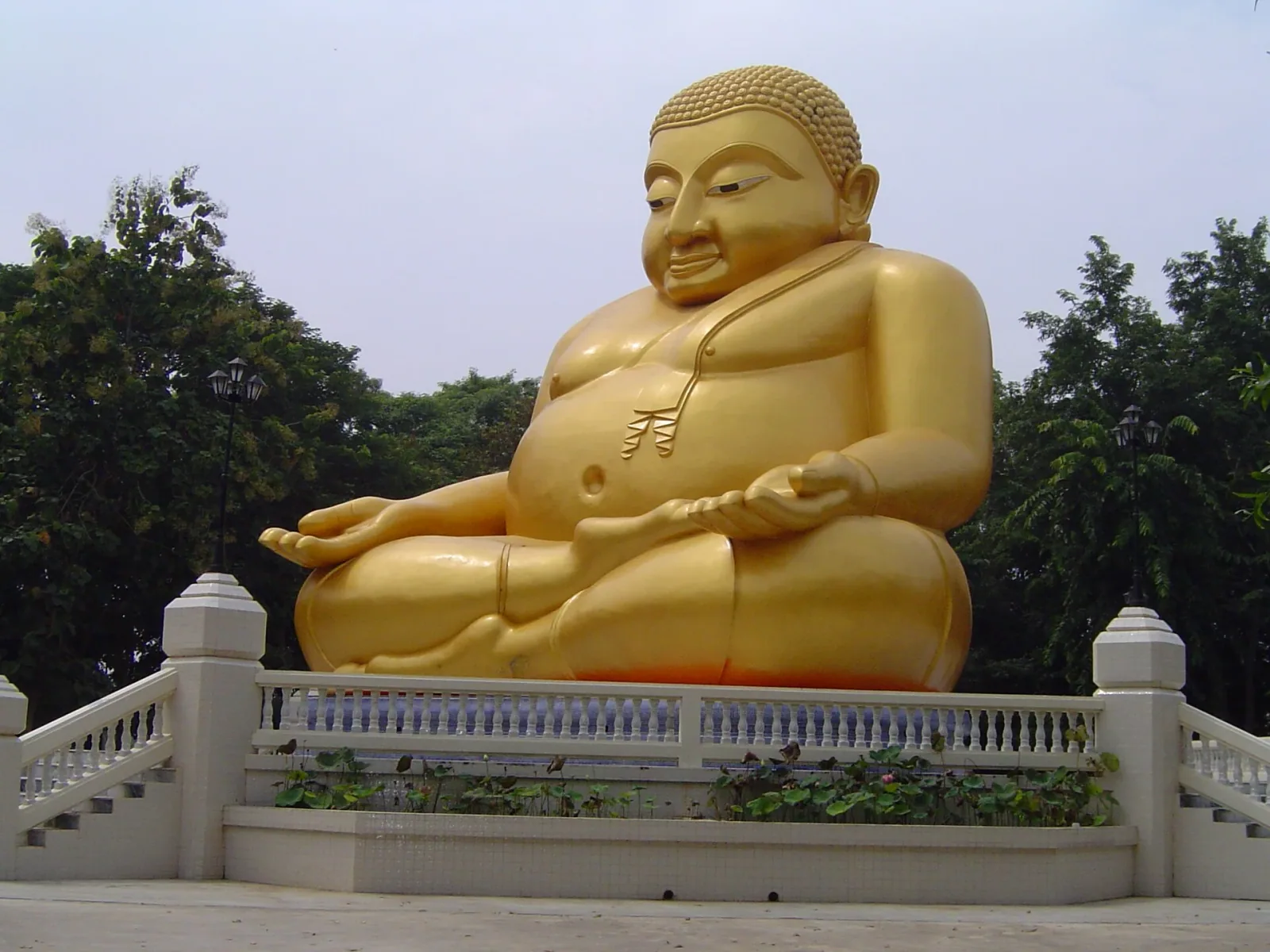
Wat Phra Non Chaksi Worawihan houses one of Thailand's largest reclining Buddha images—around 46 metres long, gilded, depicting the Buddha's entry into parinirvana. Stylistically the image is closer to Sukhothai/U-Thong than late-Ayutthaya, and the wihan that shelters it was renovated under Rama V; the original build is generally dated to the early Ayutthaya period. The temple complex includes a fine ordination hall, several smaller Buddha images, and grounds where Thai pilgrims still come to make merit. The reclining Buddha at Bangkok's Wat Pho is longer (46 m at Sing Buri vs. 46 m at Wat Pho is roughly comparable in length but the proportions differ), but Sing Buri's version sees a tiny fraction of the visitors.
What distinguishes Wat Phra Non from major Bangkok temples is the absence of tourism infrastructure and crowds. You'll likely share the space with a handful of Thai visitors, resident monks conducting ceremonies, and local families teaching children about Buddhist traditions. Entry remains free (donations welcomed, 20-40 baht typical). The atmosphere stays genuinely devotional rather than performative. Early morning visits (7-9am) coincide with monks' alms rounds and morning chanting—an immersion in active Buddhist practice unavailable at tourist-heavy temples where visitors outnumber worshippers 100-to-1.
Beyond Wat Phra Non, two more temples are worth a stop. Wat Phikun Thong, on the In Buri side of the river, is a modern pilgrimage complex centred on a very large gilded Buddha and tied to the lineage of the late Luang Phor Pae—a venerated 20th-century monk—drawing busloads of Thai merit-makers, especially at weekends. Wat Phra Prang Mueang Sing preserves a small Ayutthaya-era ruined prang at the site of the original walled city of Mueang Sing, on the west bank. These are active community religious sites, not historical attractions. Standard etiquette applies: shoulders and knees covered, shoes off inside buildings, speak quietly, don't turn your back to Buddha images.
Here's Sing Buri's most compelling argument: you can live comfortably on approximately 16,000-20,000 baht monthly ($450-565 USD). Studio apartments in the city center rent for 4,000-7,000 baht monthly—furnished, with air-con, often including WiFi. Utilities average 800-1,200 baht (electricity much cheaper than Bangkok given less constant AC needs, smaller spaces, lower rates). Food costs plummet when you adopt local patterns: street meals 30-60 baht, market meals 40-80 baht, cooking at home with market produce even cheaper. Budget 5,000-7,000 baht monthly for food with mix of eating out and home cooking. Transportation via rented motorcycle runs 1,500-2,500 baht monthly, or use local songthaews and tuk-tuks for minimal per-trip costs.
Total comfortable living easily achieves 20,000-25,000 baht monthly. Add Bangkok trips, occasional restaurant splurges, activities, and you're still under 30,000 baht. Compare this to Bangkok where equivalent lifestyle costs 40,000-60,000 baht minimum, or Chiang Mai where digital nomad infrastructure inflates prices to 35,000-50,000 baht range. Sing Buri delivers provincial-price authenticity while maintaining Bangkok accessibility—a combination increasingly rare as popular destinations gentrify under foreign resident pressure.
The compromise is minimal expat infrastructure. No coworking spaces exist. English remains rarely spoken outside a few guesthouses. Western food requires Bangkok trips or cooking yourself. Healthcare stays basic—provincial hospital handles routine needs but serious medical issues mean Bangkok hospitals 2-3 hours away. Entertainment centers on Thai markets, temples, river activities, and agricultural tourism rather than bars, clubs, or cultural events. The tiny foreign resident community (estimated 50-150 people total) consists mainly of teachers at local schools and retirees seeking maximum budget stretch. No organized expat social life exists. You're immersed in Thai provincial reality—which either sounds perfect or terrifying depending entirely on personality and language skills.
→ Studio apartment (city center): 5,000 THB
→ Utilities (electric, water, internet): 1,000 THB
→ Food (mix of street, market, home cooking): 5,500 THB
→ Motorcycle rental or local transport: 1,500 THB
→ Entertainment and activities: 2,000 THB
→ Healthcare and miscellaneous: 1,600 THB
→ TOTAL: 16,600 THB (~$470 USD)
Ultra-budget: 14,000-16,000 THB living like locals. Comfortable with occasional Bangkok trips: 22,000-28,000 THB. Still remarkably cheap with capital access.
Sing Buri sits about 142 km north of Bangkok via Highway 32 (Asian Highway 1)—a distance that creates both the province's appeal and its identity crisis. Buses run frequently from Bangkok's Mo Chit Northern Terminal (every 1–2 hours, 80–150 THB, 2–3 hours depending on traffic and stops). Minivans offer faster connections (~2 hours, 100–120 THB). Driving yourself via Highway 32 takes 2–2.5 hours on well-maintained road. There's no main-line railway station in Sing Buri itself; long-distance Northern Line trains now depart Bangkok from Krung Thep Aphiwat (Bang Sue Grand), not the old Hua Lamphong, and the nearest serviceable rail stops are at Ban Phachi junction (Ayutthaya) and Lopburi.
The arrangement appeals to specific personality types. Bangkok residents exhausted by the capital's chaos, pollution, traffic, and costs discover Sing Buri offers genuine escape at minimal expense while maintaining access to Suvarnabhumi Airport (3 hours), Bangkok hospitals, international shopping, and urban amenities. Remote workers tired of Chiang Mai's digital nomad scene or beach destination prices find ultra-affordable base with adequate internet (fiber from True and AIS delivers 100-200 Mbps for 500-800 baht monthly). Retirees on fixed incomes stretch money dramatically further while keeping Bangkok medical care accessible when needed.
But proximity creates tension. Some residents describe Sing Buri as "not quite escape, not quite Bangkok"—far enough to require commitment and travel time, close enough that you're tempted to return to the capital frequently, undermining the immersion experience. The province lacks the complete disconnection of truly remote destinations. You can always flee to Bangkok when Thai provincial life feels overwhelming. This escape hatch comforts some people and frustrates others who want forced adaptation. The arrangement works best for those viewing Sing Buri as peaceful base rather than complete lifestyle change, or for Bangkok residents seeking regular weekend escapes that feel like actual trips despite short distance.
Try the catfish strip. Several long-running restaurants along Highway 32 / Highway 311 specialise in pla chon phao (salt-crust grilled snakehead) and Chao Phraya catfish. A meal for two with rice and beer usually lands around 400–700 THB.
Buy khao lam on the way home. Roadside stalls along Highway 32 sell freshly grilled bamboo tubes of coconut sticky rice—10–20 THB each, best eaten within a day.
Use small bills. Vendors mostly work in cash; have 20s, 50s and 100s on hand for markets and roadside stalls.
The Chao Phraya River defines Sing Buri's geography and identity more than administrative boundaries. Thailand's major river flows through the province on its journey from northern highlands to Bangkok and the Gulf of Thailand. River culture permeates daily life: fishing boats depart pre-dawn, rice barges transport harvests, longtail boats ferry passengers, floating houses line quiet tributaries. The river provides both livelihood and identity—locals describe themselves as "people of the water" distinct from inland agricultural communities.
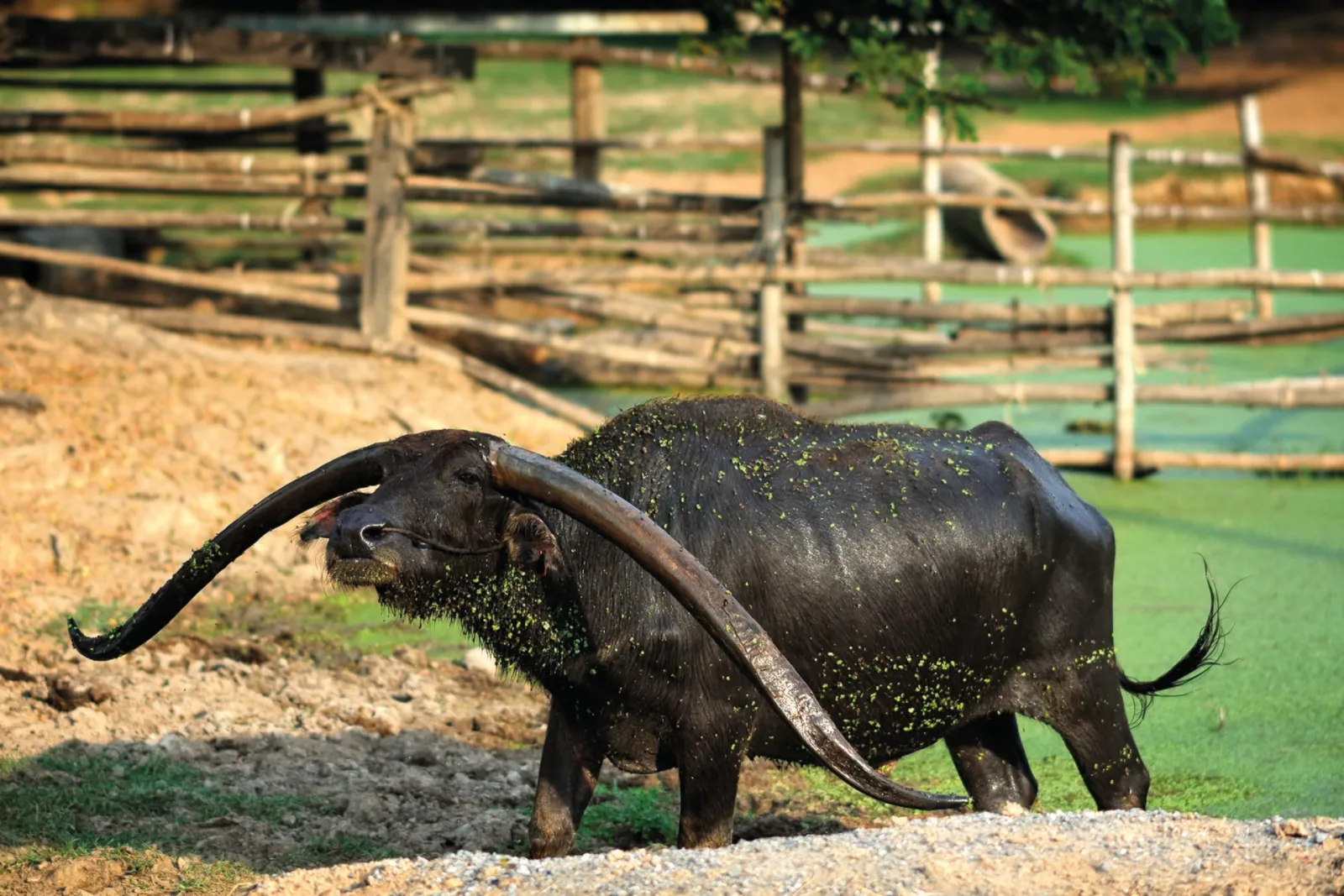
Boat tours operate irregularly through local operators rather than organized tourism companies (200-400 baht for 1-2 hour trips). You'll drift past traditional Thai houses on stilts, ancient temples backing directly onto water, water buffalo cooling in shallows, fishermen checking nets. The pace stays deliberately slow—this is observation rather than thrill-seeking. Some riverside homestays offer overnight experiences living in traditional wooden houses, eating meals with host families, experiencing river rhythms firsthand. These arrangements happen through personal connections rather than booking platforms; ask at guesthouses or temple offices for introductions.
Beyond the river, Sing Buri's plains grow rice, with planting typically April–May and harvest November–January. The flat countryside is also perfect cycling terrain—rent a bike (50–100 THB/day) and you can string together quiet paved roads between Mueang Sing Buri, In Buri and Bang Rachan through rice fields, finding small temples and old villages operating much as they have for generations. (For pomelos, you want Nakhon Pathom, Samut Songkhram or Chai Nat; for melons or river prawns, Sing Buri is fine.)
About 15 km west of Sing Buri town, the Bang Rachan Memorial Park (Khai Bang Rachan) commemorates one of Thailand's most celebrated resistance stories. As the Burmese army advanced south toward Ayutthaya in late 1765, villagers led by figures including Nai Thaen and Nai Chan Nuat Khiao fortified a stockade in Bang Rachan and held off eight successive Burmese assaults over roughly five months, before the camp finally fell in February 1766. Ayutthaya itself collapsed in April 1767. These farmers were untrained in warfare and outgunned, and their sacrifice entered the national mythology as an exemplar of patriotic courage against overwhelming odds.
The memorial complex includes a small museum, statues of the eleven recognised leaders and an educational centre documenting the battle. Thai schoolchildren visit on field trips; the annual Bang Rachan Heroes commemoration in mid-February draws Thai visitors paying their respects. Entry is free (donations accepted). English-language information is limited, so reading the background beforehand—or hiring a guide at the gate—helps. Nearby Wat Phokhao Ton is traditionally identified as the temple inside the original stockade.
For more layered history, head to the Inburi National Museum, set on the grounds of Wat Bot in In Buri district. The collection focuses on artefacts from the Mae Nam Noi kiln sites—a major medieval ceramics production area on the Noi River that supplied glazed jars, vessels and roof tiles across the Ayutthaya kingdom and as far as Sukhothai and the trading ports. It's a quieter, more academic stop than the better-known historical parks at Ayutthaya or Sukhothai, but it grounds Sing Buri firmly in the kingdom's economic and military map.
Sing Buri works brilliantly for Bangkok escapists seeking provincial authenticity without complete disconnection from the capital, budget-conscious travelers and residents prioritizing ultra-low costs while maintaining modern amenities access, river and agricultural culture enthusiasts interested in traditional Thai life, photographers seeking authentic markets and rural landscapes without tourist interference, and remote workers who've done the popular digital nomad destinations and want something genuinely different.
Sing Buri struggles for families needing international schools (nearest options in Bangkok), travelers requiring sophisticated medical care (provincial hospital adequate for routine issues but serious conditions need capital facilities), people expecting Western amenities or extensive English-language support, anyone seeking active nightlife or entertainment beyond Thai cultural activities, and those wanting complete escape from Bangkok's orbit. The province exists in limbo: close enough to feel Bangkok's influence, far enough to require real commitment. That in-between status either feels perfect or unsatisfying depending entirely on what you're seeking.
Ultimately, Sing Buri matters because it demonstrates what provincial Thailand offers when tourism hasn't arrived to transform (and arguably corrupt) local culture. The floating market functions. The temples practice Buddhism. The river sustains communities. Agriculture continues. Thai life operates for Thais, with foreigners welcome as observers and participants but never as the point. This authenticity creates both Sing Buri's appeal and its challenges—you get genuine Thailand, which means dealing with genuine Thai reality without the smoothing effects of tourism infrastructure. For travelers and residents who've grown tired of Thailand's greatest hits and want something real, affordable, and accessible, Sing Buri delivers precisely what Bangkok's shadow concealed for decades. The province won't suit everyone. Those it suits will wonder why it took so long to discover Bangkok's peaceful, authentic, ridiculously affordable neighbor hiding in plain sight two hours north.
Population
~205,000 (and shrinking)
Area
~817 km² (one of Thailand's smallest)
From Bangkok
~142 km north via Hwy 32
Region
Central Thailand
Emergency
191 (Police), 1669 (Medical)
Quick Take
A small central-plains province on the Chao Phraya, anchored by the Bang Rachan heroes' story, the 46-metre reclining Buddha at Wat Phra Non Chaksi, and a strong freshwater-fish food culture. Close to Bangkok and Ayutthaya, much quieter than either.
Best For
Bangkok escapists, budget travelers, river culture enthusiasts, remote workers, retirees seeking ultra-low costs with capital access
Cool Season
Nov-Feb · 15-28°C, perfect for exploring river and temples
Hot Season
Mar-May · 35-40°C, challenging outdoor activities
Rainy Season
Jun-Oct · Afternoon storms, potential flooding near river
→ Wat Phra Non Chaksi (46m reclining Buddha)
→ Bang Rachan Memorial Park & statues
→ Wat Phokhao Ton (Bang Rachan stockade site)
→ Inburi National Museum at Wat Bot (Mae Nam Noi kilns)
→ Wat Phra Prang Mueang Sing (old city ruins)
→ Wat Phikun Thong (modern pilgrimage temple)
By bus
Bangkok Mo Chit · 2–3 hrs · 80–150 THB
By minivan
From the Northern Bus Terminal · ~2 hrs · 100–120 THB
By car
Highway 32 · ~142 km · 2–2.5 hrs